ART HISTORY TITBITS RELATING TO OUR WEEKLY THEMES - WRITTEN (unless specified) BY HAYLEY WHITTINGHAM
Cubist forms
Following on from the ‘paper shroud’ session, this week our model will be posing against piece of giant origami. This will create a backdrop of geometric shapes and dramatically lit planes. Inspiration for drawing the figure within such a structure may be taken from artists working in styles derived from cubism.
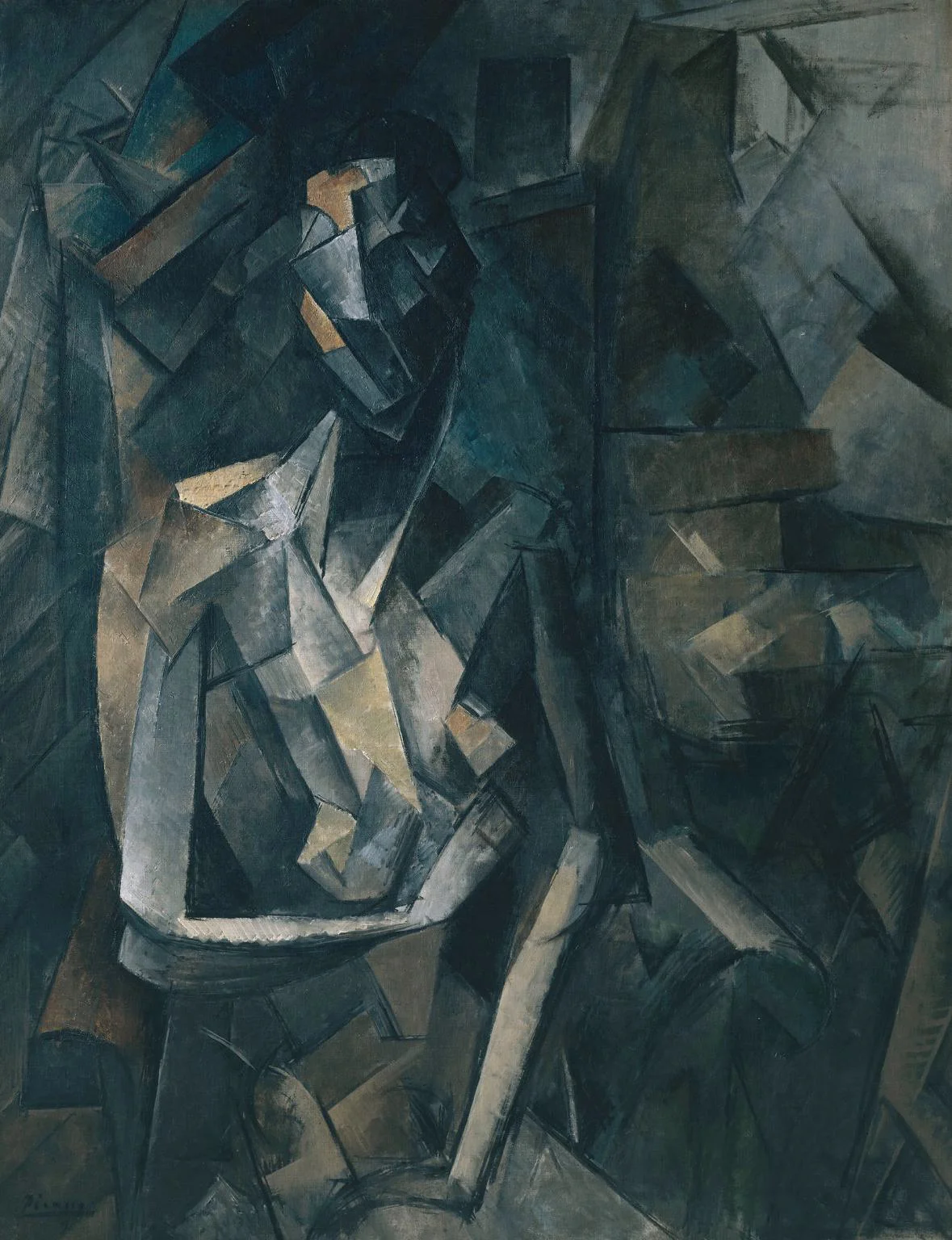
Picasso was one of the pioneers of cubism. In the early years, he constructed his images using small facets, or geometric planes, like those in origami. ‘Figure dans un fauteuil’ is one of his paintings in this style. Not only is the background broken up into geometric planes, but the figure is too. She appears mechanistic, and as if she is being engulfed by the shapes of the background, where you can only just make out an armchair. Despite this semi-abstraction, the tonal variation of the planes suggests the direction of the light and three-dimensionality.

Picasso, Figure dans un fauteuil, 1909
Another early cubist painting is Jean Metzinger’s ‘Deux Nus’. The models are portrayed from multiple view-points and at successive intervals in time shown simultaneously on the canvas. It results in a fragmented image of interlocking planes, which looks almost like a view in a broken mirror. The figures, the rocks and trees are all treated in the same way, blurring the distinction between background and foreground with only the colour variation helping to decipher the scene. Despite this, Metzinger still manages to render the nudes in a convincing and elegant way.

Jean Metzinger, Deux Nus, 1911
Wyndham Lewis was one of the artists involved in the development of Vorticism in England, a movement which owed a debt to French cubism and Italian futurism. Like Picasso’s cubist painting, Lewis’s ‘Figure composition’ depicts fragmented space using sharp angles. Line thickness is varied in order to make things recede or project. The straight lines in the background and the sweeping curves that make up the figures come together to evoke the architectural and mechanistic rhythm of urban life, as they walk their bulldogs. In a similar way, a background of origami could be treated like a scaled-down architectural form.

Wyndham Lewis, Figure Composition (Man and woman with two bulldogs) 1912-13
These three artists demonstrate how the figure can be drawn against a background of geometric planes, in order to blend in or stand out to varying degrees.
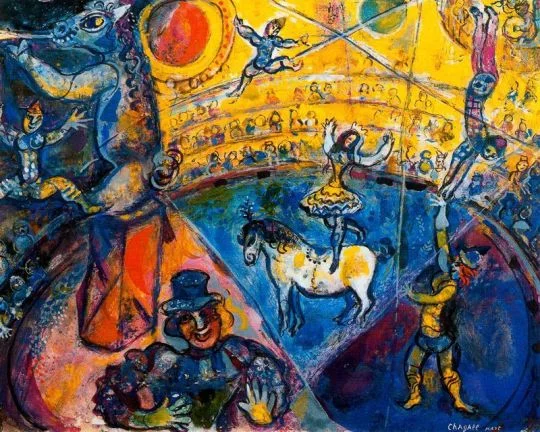
The Circus
Throughout the 19th and 20th century many artists turned to the modern city and its late night entertainment for their subjects, including the circus. They made innovate use of colour, perspective and movement to convey its vibrant atmosphere.
‘The Circus’ is the third panel in a series by Seurat, whose style evolved from impressionism. It is seen as one of the most successful applications of his theory of divisionism – placing small strokes of contrasting colour side by side so that when seen from a distance they blend to create the effect of luminosity. This can be seen most clearly upon close examination of the stage floor, which is made up of a combination of red, yellow and blue dots. Only the three primary colours and white are used, but flat colour is nowhere to be found. This technique conveys the vibrancy of the circus.
The canvas is divided into two spaces – the stage and the audience. As well as being divided spatially, it is divided by motion. Whilst the audience’s space is geometric and rigid, movement is injected onto the stage space in the foreground using the strong dynamic curves of the circus ring, acrobat’s bodies and ringmaster’s whip. Seurat depicts the circus as a vortex of energy.

Seurat, The Circus, 1891
German expressionist painter Kirchner saw Berlin as a city of excitement and glamour, but with an undercurrent of artificiality and chaos. He painted urban life and the everyday world, with a particular interest in human naturKirchner was drawn to the circus for its constant action. He wrote in his manifesto “I believe that all human visual experiences are born from movement.” He often sketched the action from life whilst seated in the audience, later working up the surface texture to inject movement into the canvas. He uses pictorial devices to capture the full sensory experience of an observer at the circus. His revolutionary use of colour conveys the vivid costumes of the performers, whilst the compressed composition and angled perspective forces everything into one plane of space, recreating the claustrophobic sense of being enclosed in a circus bursting with noise and energy. The circus would bring together an audience from diverse classes and backgrounds, providing a wide range of human subjects to sketch. Kirchner’s unnatural colour and perspective come together to communicate the heightened artificiality of the urban spectacle.

Ernst Ludwig Kirchner, Circus, 1913
The circus was an influence on Chagall throughout his life, beginning with a fascination with the travelling acrobats he saw at village fairs as a child in Russia. When he lived in Paris he would regularly visit the circus to sketch from the audience like Kirchner. This explains the similar dramatic perspective in ‘The Circus’ which situates the viewer as a member of the audience looking down on the performers. He was captivated by the chaotic and colourful atmosphere. The circus performers in their extravagant costumes and garish makeup fitted perfectly into his dream like compositions. He said, ‘For me a circus is a magic show that appears and disappears like a world.'The primary attraction of the circus for these artists was the microcosm of life it contained, from the comic to the tragic as well as the broad range of social classes it brought together.

Marc Chagall, The Circus, 196
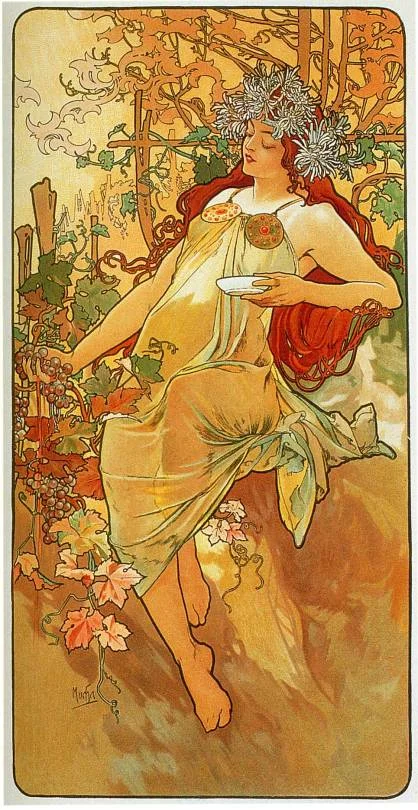
Autumn
Autumn is a timeless subject in art, returned to again and again for its rich colours and symbolic meanings by artists such as the pre-Raphaelite brotherhood. The pre-Raphaelite artists advocated intense study of nature, and had a fascination with medieval culture, creating paintings full of detail and intense colour.
Millais’ ‘Autumn Leaves’ shows four girls raking fallen leaves by twilight, for a bonfire. The orange tones of the large pile of leaves in the foreground harmonise with the warm evening sky. It hints at the beginnings of the aesthetic movement, with an emphasis on beauty over meaning. The sharp focus of the leaves is created using many thin glazes over a white ground, retaining a jewel like clarity of colour as the light travels through the layers and is reflected back.
Despite the emphasis on the beauty of nature and of the girls, autumn has a symbolic meaning for Millais. It represents the transience of this youthful beauty– the leaves eventually fall from the trees and are turned into smoke. He may have been inspired by the romantic poetry of his friend Tennyson, and the experience of sweeping up leaves together in his garden.

John Everett Millais, ‘Autumn Leaves’, 1856
Many British artists in the 1890s were influenced by French naturalism. The influence spread through artist’s colonies such as Grez Sur Loing in France, where British artists mixed with French and American artists like a painter’s holiday camp. William Stott of Oldham was one of these artists, as well as being a close follower of Whistler, the father of Aestheticism. In his painting ‘Autumn’ a woman in a red dress with deep auburn hair sits on an abundance of golden grasses and rosy apples. Whilst the colours are immediately evocative of Autumn, the harvest also conjures up autumnal vibes. The word harvest came from the Old English word hærfest, meaning “autumn”. The scene combines Stott’s early interest in landscape painting with his later development toward allegorical themes. The romantic undertones of the elegantly draped woman in nature shows the influence of pre-Raphaelite artist Edward Burne Jones.
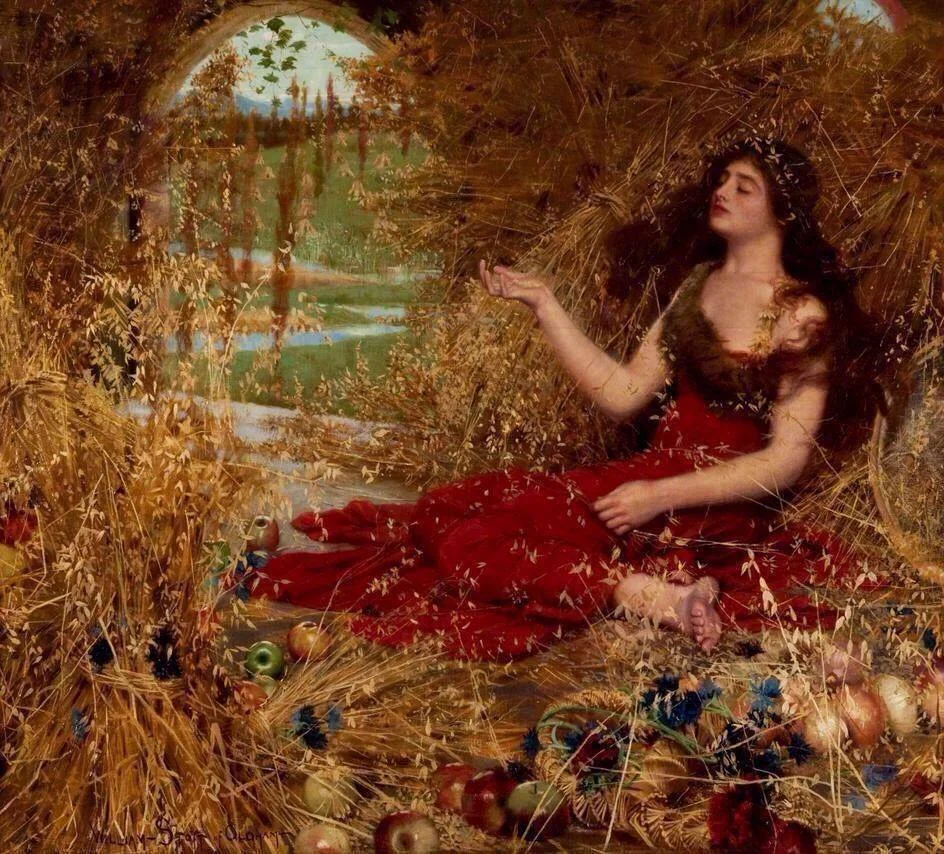
William Stott of Oldham, ‘Autumn’, 1898
Alphonse Mucha takes the associations of autumn and the female figure one step further and represents a female figure as an allegory of autumn itself. The personification of the seasons in art dates back to the old masters, but Mucha injects new life into the classic theme using an Art Nouveau style. Art Nouveau was a reaction to academic art, inspired by natural forms and the curved lines of plants and flowers, and often designed to be mass produced. Mucha’s ‘Autumn’ is part of a series of the four seasons, each depicting a woman with the attributes of her season. Autumn is a playful figure, wearing a wreath of chrysanthemums in her red hair. She sits amongst a rich tapestry of autumnal fruits and leaves, capturing the mood of fruitful autumn. Like Millais, Mucha touches upon the association of women with death and rebirth, as the symbolic meaning of Autumn.

Alphonse Mucha, ‘Autumn’, 1896
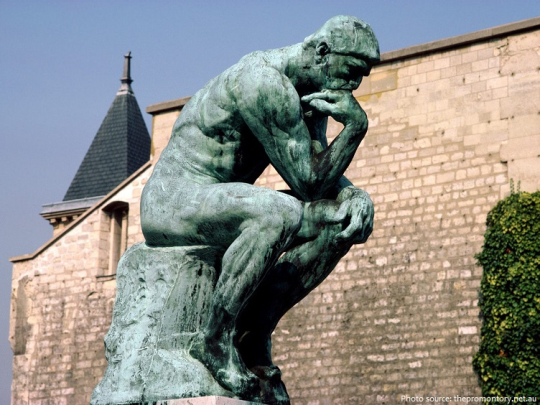
Rodin
In Rodin’s extensive oeuvre of drawing and sculpture, the human body takes a primordial role. He built up an anatomical catalogue of powerful musculature and twisting poses through observation of the model, but going far beyond anatomical accuracy, he used the body as a vehicle for expression of the soul.
Despite being famous for his sculpture, Rodin produced around 10,000 drawings throughout his career. Contrary to expectation the majority were not intended as studies for his sculpture but works of art in their own right. He said “It’s very simple. My drawings are the key to my work.” They offered him a means to explore the human figure with freedom and spontaneity before transferring the lessons he learned into three dimensions. Dancing Figure from 1905 demonstrates his free flowing line, giving a sense of movement. He preferred to work from his models in motion rather than academic poses. He would get them to move around the studio taking up natural poses whilst he drew, without taking his eyes off the model. He is known to have kept an address book of his models of all ages and genders with details on their physical characteristics.

Auguste Rodin, Dancing Figure, 1905.
Rodin’s method of drawing created anatomical distortions which translated into innovations in sculpture that moved away from accepted conventions for representing the figure. It would be impossible for a model to hold the natural poses he sought for as long as it would take him to sculpt them, but he used his memory as the source for spontaneity.
He frequently returned to dance as a subject, possibly motivated by his desire to capture the impulses of the soul through movement. For this reason he wasn’t interested in the disciplined style of classical ballet, but preferred the free and experimental dance of the Ballets Russes, Isadora Duncan and Nijinsky, whom he saw in performance of Debussy’s L’Après-midi d’un faune in 1912.
Nijinksy posed for Rodin that same year. In this sculpture he is depicted bringing his leg into his chest in an awkward pose reflective of his dance style, with the other leg bent as if he is about to leap in the air. The sculpture has a strong profile which pays tribute to Nijinsky’s choreographic style, inspired by Greek bas-relief sculpture.

Rodin, Nijinsky, 1912.
One of Rodin’s most iconic sculptures is ‘The Thinker’, although it was originally conceived on a smaller scale as part of ‘The Gates of Hell’, inspired by Dante’s Divine Comedy. The thinker is believed to represent Dante, observing the circles of hell from the top of the gates, whilst lost in thought about his work. For this reason it is designed to be seen from below and the top half of the body appears enlarged to compensate for this. Once again Rodin uses the body as an expression for the soul, this time an almost damned soul who is transcending his suffering through poetry and silent contemplation. The figure’s nudity relates back to the heroic tradition of Michelangelo whose work Rodin admired, making it a more universal representation of intellect. It was enlarged as an individual piece in 1904, which emphasises the powerful musculature of the figure and suggests more of a capacity for action as well as philosophy.

Rodin, The Thinker, 1904.
Vertical bed
The main motivation for a vertical bed as a life drawing prop is to draw reclining poses without the pesky foreshortening. It’s a simple way to create the illusion of a bird’s eye view. However several artists have shown how the vertical or bird’s eye view of the bed can be employed to interesting effect in its own right.
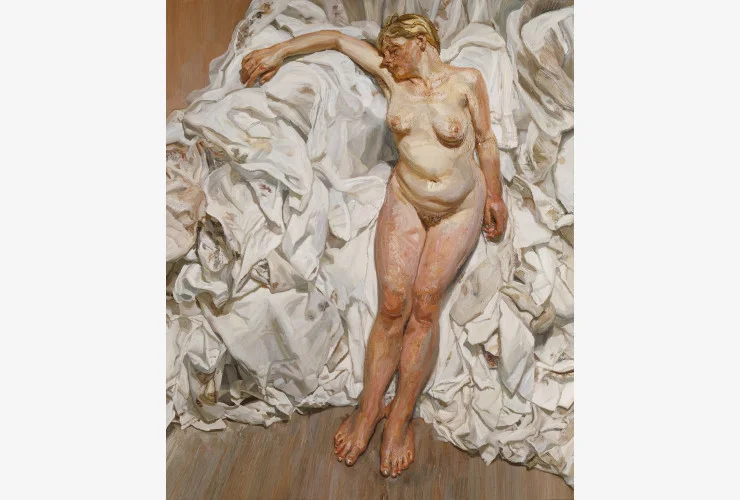
Freud often worked with the motif of the mound of rags as he had a large pile in his studio which he used for wiping brushes, doubling up as a prop for his models. ‘Standing by the Rags’ recreates the effect of the ‘vertical bed’ as the shallow picture depth makes it ambiguous whether the figure is standing or lying. The pose looks simultaneously comfortable and awkward. It is as if the model is nestled into the rags but her weight is not quite supported and the whole thing could collapse at any minute (as vertical beds have a habit of doing!). In fact the pose was possibly inspired by the tradition of deposition paintings that showed Christ being lowered from the cross, with the rags standing in for the supporting figures.This would elevate the painting to the status of an altarpiece. Freud gives equal attention to the detail and texture of the rags and the figure, drawing a comparison between the folds in the fabric and the folds in the skin. Meanwhile the cool tones of the rags contrast with Freud’s warm, ruddy flesh palette.

Lucien Freud, Standing by the rags, 1988-89.
Contemporary artist Lee Price makes photo-realistic paintings about women’s relationship with food, often from a bird’s eye view. Every one of her works is a self-portrait, and the viewpoint is not one of the voyeur but of the subject looking down on herself, as if in an out of body experience. Nevertheless there is a tension created between privacy and disclosure in the private setting of the bed. Whilst most of Price’s paintings feature women eating mountains of junk food, the bowl of peaches and sleeping figure make this a transitional piece, where food is no longer an all-consuming object associated with guilt but a source of nourishment. This peaceful mood is reflected in the surroundings of rippled white sheets. The sequence of images featuring variations on the composition evokes the natural shifting of position during sleep, suggesting the passing of time. In a similar and equally beautiful series, Price paints women in the bath from a birds eye view. Definitely worth a look!

Lee Price, Sleeping with Peaches, 2011.
Another triptych, Vincent Desiderio’s ‘Sleep’ is an epic 24 foot painting of figures sleeping side by side from a bird’s eye view.The tableau of figures lined up creates an anonymity as each individual gets lost in a pattern of shapes and drapery, and their faces fall into the shadows. This could be a creative alternative to producing many quick drawings on separate sheets of paper. ‘Sleep’ was intended to represent a communal sleep - the sleep of our culture, or the sleep of reason, a subject famously depicted by Goya in his suite of satires ‘Los Caprichos’. You may recognise the painting from rapper Kanye West’s appropriation for a voyeuristic view of 12 celebrities in his music video ‘Famous’, which appropriately made Desiderio’s ‘Sleep’ famous.

Vincent Desiderio, Sleep, 2008, with Kanye West, Famous, 2016.

![Getting [un]dressed](https://images.squarespace-cdn.com/content/v1/5c2034e75417fc423a175501/1546812354542-7HAONZ3KCRZYKTCSW109/Antoine+Watteau%2C+The+Toilette%2C+1717.%C2%A0.jpg)