ART HISTORY TITBITS RELATING TO OUR WEEKLY THEMES - WRITTEN (unless specified) BY HAYLEY WHITTINGHAM
Rope
Ropes can be used as a prop for life drawing in order to draw attention to the geometry of the figure and individual poses. The interaction of a model with rope creates interesting internal and external structures which help to identify angles. Many painters and sculptors have used ropes or geometric structures to represent the figure in innovative ways.
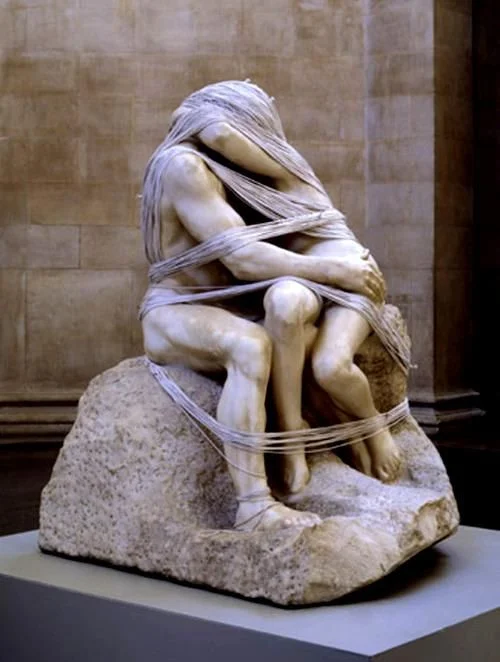
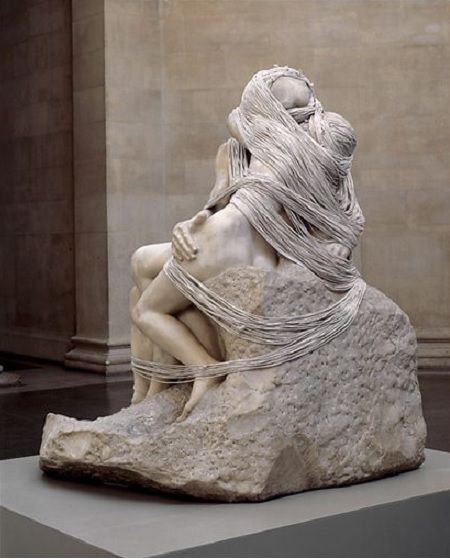
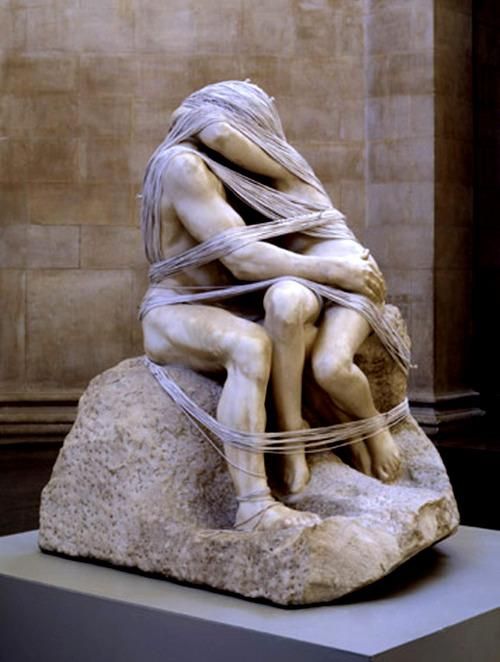
Artist Cornelia Parker wrapped Rodin’s ‘The Kiss’ in a mile long piece of rope, and retitled it ‘The Distance (a Kiss with added string)’ 2003. As with much of her work she takes something familiar and alters it to add a new layer of meaning. The rope does not function here as physical bondage but is symbolic of the constrictions of relationships. The two lovers are so wrapped up in each other that it becomes claustrophobic. It was a controversial piece, seen by some as an exploitation of Rodin’s original work, and one viewer was driven to vandalise the rope with scissors to set the lovers free. There is an interesting contrast between the hard marble of high art, and the impermanent string of low art. Whilst the original work was considered indecent in its day, Parker highlights the way in which partial concealment can increase erotic charge.
At 26 metres tall, Anthony Gormley’s complex geometric metal sculpture ‘Exposure’ is difficult to read up close, becoming an abstract frame for the landscape. However from a distance the composition of straight lines and angles morphs into an accurately proportioned three dimensional crouching man, The 2,000 components were fabricated by a pylon manufacturer in East Lothian and then shipped to the Netherlands for assembly. The sculpture itself is inspired by the economy of means and the connectivity of the pylon. Gormley began by making a cast of himself in the desired position, and then algorithms were used to design the geometric structure so what it would describe the forms of the body whilst maintaining structural integrity. The most concentrated meeting points of the lines happen at the head, throat, heart, stomach and genitals, which roughly corresponds to the “chakras”, or energy points, of ancient Hindu thought. In this way the sculpture portrays the body as an energy system as opposed to the anatomical. The transparency of the form could be carried over into life drawing by focusing on the continuous line formed by the rope and not the figure itself.

Anthony Gormley, Exposure, 2010
Pamela Phatsimo Sunstrum uses the subject of the figure to construct diagrams or maps, which appear to be governed by unknown geometric principles. Figures often overlap in her work to suggest compounded time, and a universal, atemporal existence. Straight lines link the extreme points of the figures like taut strings, travelling both within and beyond their forms. The encasing geometric structure gives them a monumentality. Sunstrum’s work explores the parallels between ancient cosmology and advanced theories in science, appearing simultaneously futuristic and ancient, like a constellation map.
Like Gormley, her figures are all modelled on herself, using her training as a dancer to explore existential narratives and scientific and mathematical theories. “I’m curious about how arms can hang, how knees can bend, how a back can twist to suggest an entire identity or history even if it’s an invented one.”
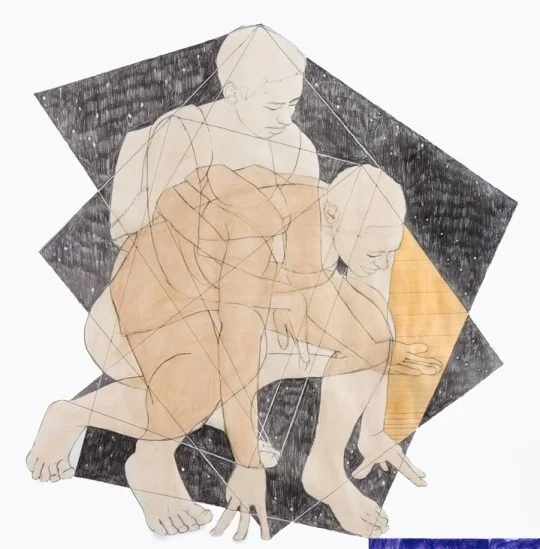
Pamela Phatsimo Sunstrum, Panthea 01, 2016
Reading
It may come as a surprise that a work of art depicting a woman reading could be controversial in the past. Reading indicated education, and in the Victorian fin de siècle, this conjured up associations with the ‘New Woman’. The New Woman was educated and independent, and a threat to conventional ideals of womanhood. Women were demanding the right to university education, and to be acknowledged as intellectually capable—in other words, equal to men.
When artist Aubrey Beardsley began his career in London in 1892, these issues were being vigorously debated in popular journals and newspapers. His work is supportive of education for women, emphasising the value of books. One such drawing featured on a catalogue cover from ‘A second book of fifty drawings’, 1899. A fashionably dressed woman sits reading at home, with only a cockatoo for company. The domestic interior is conveyed through an economy of line, in a work suitable for reproduction in print. Beardsley was heavily influenced by Whistler, and may have found inspiration for his subject in Whistlers ‘Reading by Lamplight’ 1858, which uses a similar composition. It shows Whistler’s half-sister, reading at night with a cup of coffee. She sits within an aura of light, with the book right up to her face. For working class women, to be caught reading was tantamount to neglect of family responsibilities. For this reason many read in secret, as Whistler’s sister may be doing, pioneering modern notions of privacy and intimacy.

Aubrey Beardsley, A second book of fifty drawings’, 1899

Whistler, ‘Reading by Lamplight’, 1858
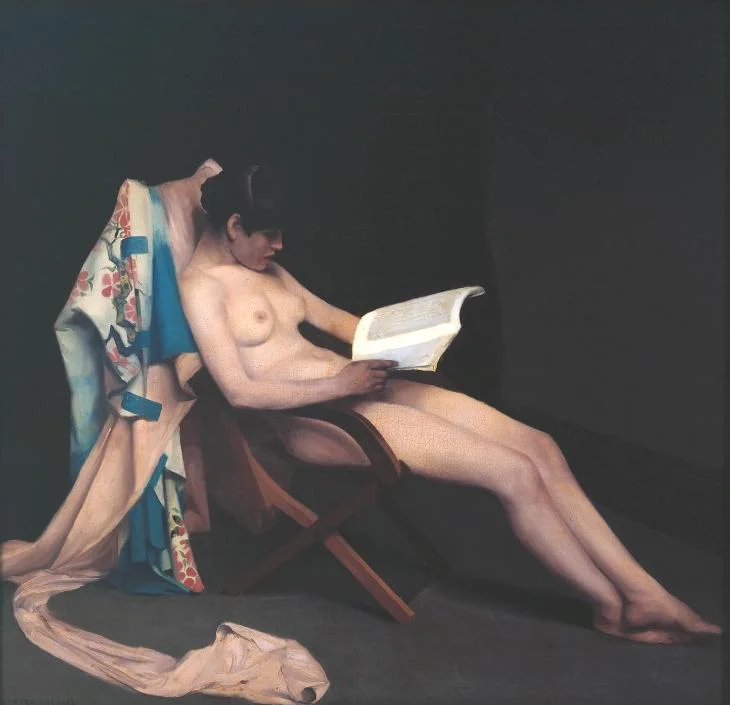
Theodore Roussel was a close friend and pupil of Whistler, and they shared a love of Japanese art. These influences are seen in ‘The Reading Girl’, 1886-7, in the patterned kimono draped over the back of the chair, and the strong horizontals and verticals of the composition. Roussel’s depiction of a reading woman differs from that of Whistler and Beardsley by her nudity. This frank nudity and flattening of form pays tribute to Manet’s Olympia, controversial in its time. Likewise, Roussel’s painting received harsh criticism for its depiction of a nude woman in neither a classical or mythological guise, but an everyday setting, reading a newspaper. More recently, female art historians have interpreted it as a depiction of ‘an intellectual, modern woman who is not sexually available, despite the nudity’. In this way the traditional passive female nude, object of the male gaze, is subverted by the suggestion of education.
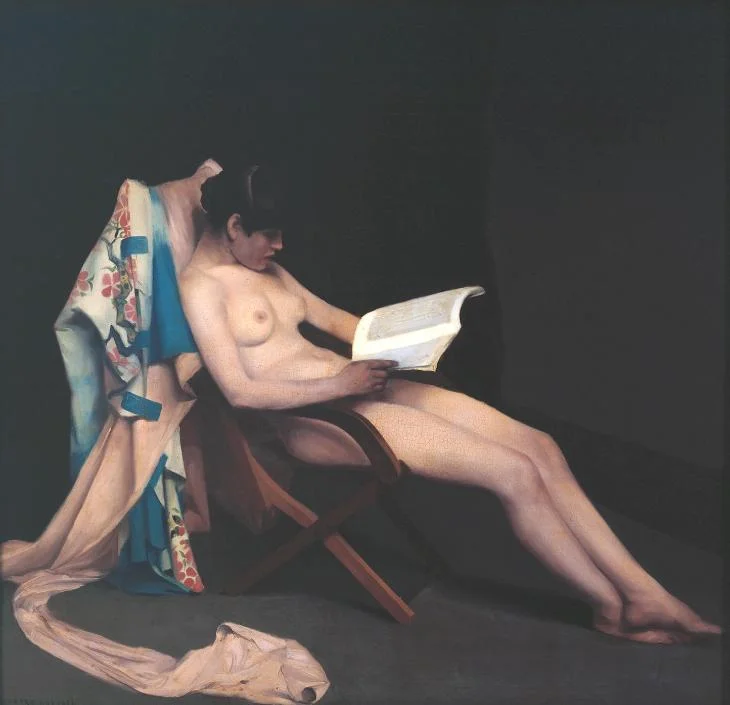
Theodore Roussel, ‘The Reading Girl’, 1886-7
These works from the Nineteenth-century can be compared with more recent portrayals of the same subject such as Roy Lichtenstein’s ‘Nude Reading’ 1994. He took his inspiration from an image in the comic book Girls’ Romances, from 1963, in which the girl was fully dressed, accompanied by the caption ‘I had read about love’. Now in the Nineteenth century the women’s novel was viewed as a threat to the husband and head of the family, as it had the potential to excite the passions and stimulate the imagination. Lichtenstein stripped his source image naked, and combined with knowledge of the original caption, it harks back to the same nineteenth-century concerns with novels aimed at young women. Much like the representations of that period, she is pictured in a private setting, fully absorbed in her book. As well as being suggestive of the type of material she may be reading, the nudity of Lichtenstein’s girl relates her to the timeless tradition of the woman reading in art.

Roy Lichtenstein, ‘Nude Reading’, 1994.
![Getting [un]dressed](https://images.squarespace-cdn.com/content/v1/5c2034e75417fc423a175501/1546812354542-7HAONZ3KCRZYKTCSW109/Antoine+Watteau%2C+The+Toilette%2C+1717.%C2%A0.jpg)
Getting [un]dressed
A figure depicted in the process of getting dressed or undressed calls into question the difference between nudity and nakedness. Art historian Kenneth Clark might argue that this is a depiction of nakedness, as it highlights the deprivation of clothes. As John Beger sums up in ‘Ways of Seeing’ – “Nakedness reveals itself. Nudity is placed on display. To be naked is to be without disguises.“ The body in the process of being revealed or concealed is by his definition nakedness.
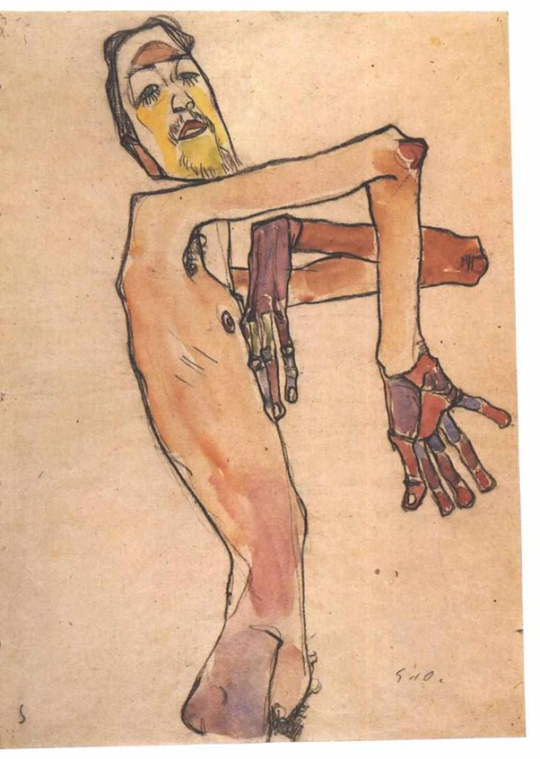
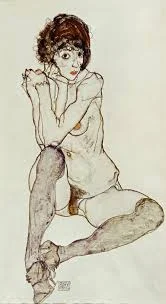
The semi-clothed figure has also been the subject of art historical debate. French Philosopher Diderot argued that partial nudity is more indecent than full nudity, as it suggests that the subject is exhibiting themselves as opposed to being stumbled across in their natural state – think Egon Schiele’s erotic drawings.
There is a tradition of painting women getting undressed in the ‘toilette’ scene, where they prepare themselves for the day ahead. Until the mid 19th century these featured primarily middle class women, who even in these most intimate acts are deprived of privacy by the presence of a servant. Rococo painter Watteau’s ‘The Toilette’ is part of this tradition. The woman sits on a chaise longue and lifts off a white gown, forming a dynamic circular shape through her pose. A maid holds what is presumably her bath towel. Despite the presence of the maid, the painting retains a sense of voyeurism through its central composition and lighting, as though viewed through a keyhole. The woman peers in the direction of the viewer from between her arms, perhaps by coincidence. The work was actually based on a drawing made from a female model whom Watteau hired to pose in a rented room, as they only used male models at the Academy. It was extraordinary in its time for showing a female nude not in the context of history painting, but engaging in the rituals of daily life.

Antoine Watteau, The Toilette, 1717.
Like Watteau, Bonnard concentrated on the mundane activity of everyday life as opposed to an idealised, mythological subject. He continues the theme of the ‘toilette’, bringing it into a more modern context with the recognisable bathroom setting. Such a theme was still a common excuse for painting a nude, in the case of Bonnard, often getting in or out of the bath. ‘Nude with green slipper’ probably depicts his wife Marthe. She is completely naked except for a pair of green slippers, and a pile of clothing lies at her feet. This time the woman has complete privacy in dressing, and the titillating voyeurism of Watteau is replaced by casual intimacy, her face hidden as she bends over as if to shave her legs. The isolated presence of the green slippers brings to mind Diderot’s argument, “Imagine the Medici Venus is standing in front of you, and tell me if her nudity offends you. But shoe this Venus’ feet with two little embroidered slippers…and you’ll feel the difference between decent and indecent quite vividly.” The domesticity of Bonnard’s scene and the fact the woman is in the process of getting dressed lessens the ‘indecency’ of the image. However it still has an unusual effect simply because we are unaccustomed to seeing a nude wearing only their shoes.
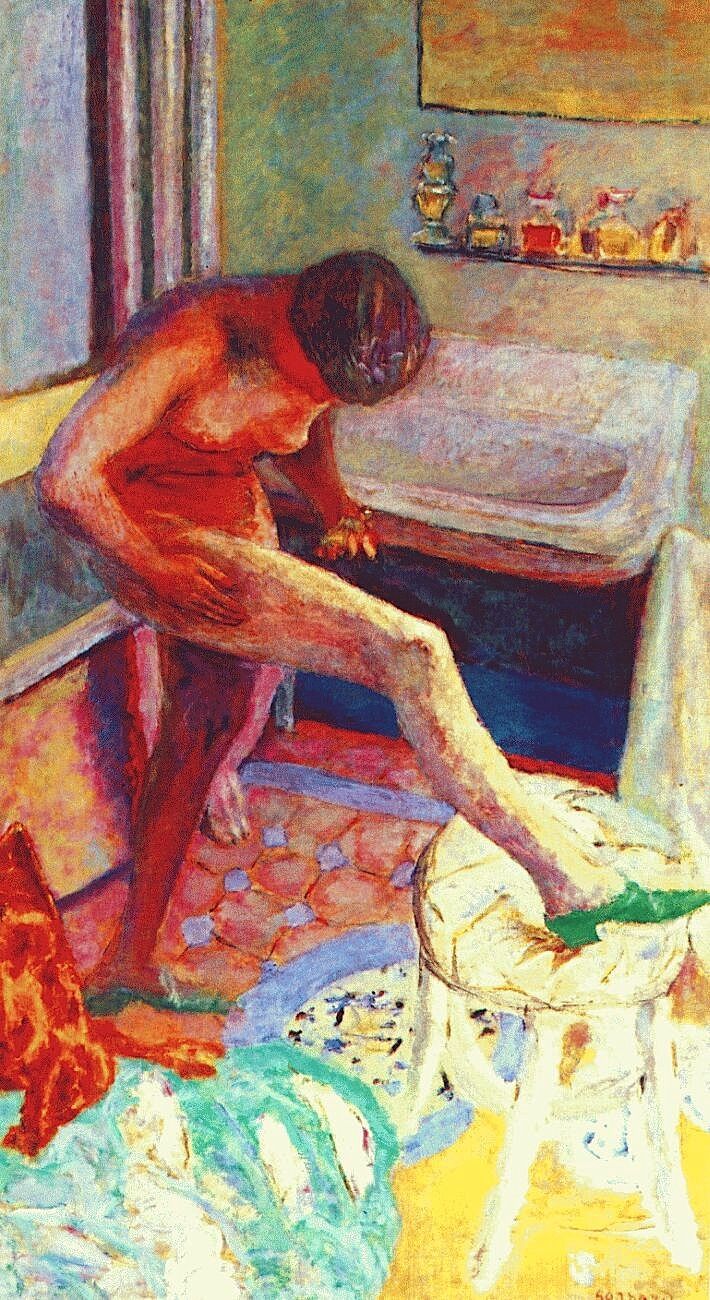
Pierre Bonnard, The Green Slipper, 1927.
Gustave Caillebotte’s ‘Homme au bain’ is the male equivalent of a Bonnard. A man stands beside a bath, wrapped in a towel, with his clothes folded neatly on a chair alongside his boots. Again, the presence of clothing emphasises the figure’s ‘nakedness’, as we are made aware of something having been removed. Feminist critics have argued that images of nude females at their toilette were associated with prostitution in the 19th-century France. Thus, Caillebotte’s image challenges traditional notions of masculinity and gender norms in domestic settings. Masculinity is contrasted with vulnerability, as the man stands with his back to us and his buttocks exposed. The space is halfway between Watteau’s ‘toilette’ and Bonnard’s bathroom, a small area covered by a curtain for some degree of privacy. The mundane or unidealised nature of the subject is emphasised by the crumpled white cloth and wet footprints on the floor, suggesting that he is in a hurry to complete his morning routine.

Gustave Caillebotte, Homme au bain, 1884.

Rotate/sequence
Drawing a rotated pose can assist in understanding the figure in three-dimensional space, as we learn what is happening from every angle. This will not only improve the drawing itself, but can be applied to sculpture or animation using the drawings as a starting point. The following are three examples of how artists have rotated a single pose to achieve different artistic goals.
Raphael uses a similar pose from three different viewpoints in his version of ‘The Three Graces’ from classical mythology. Whilst the two outer figures are in mirroring poses, the central figure is a rotation of the one on the left. Through their placement, the figures form a loop, each linked by a hand on another’s shoulder. This forms a pleasingly rhythmical composition, and conveys their sisterly affection. The irregularity caused by the rotation and mirroring of the pose may be intended to reflect the imperfect cyclical patterns of nature’s movements. It is believed to be the first study that the 17 year old Raphael made of the female nude from both the front and back, and the repetition of a single pose from different viewpoints would have simplified the task. The orbs they hold could be rosy apples – identifying them as the handmaidens of venus. Subtle variations differentiate them as the feminine virtues of chastity, beauty and love. The goddess on the left wears a transparent veil around her hips, representing Chastity, whilst the woman on the right may be beauty, with her red beaded necklace. The three Graces is an example of how a single rotated pose can be repeated and overlapped within a scene to create a harmonious composition with depth.

Raphael, The Three Graces, 1505
Philippe de Champaigne made a triple portrait of the Cardinal de Richelieu in 1642, rotating his sitter 90 degrees each time. It makes for an interesting image, where in the two facing profiles he appears to be conversing with himself. The real purpose of the painting was as a study for a bust – it was sent from Paris to Rome where the Italian sculptor Francesco Mochi had been commissioned to make a statue, as he was unable to travel to work from the sitter himself. Three viewpoints are preferable to one when it comes to capturing a sitter’s three-dimensional presence, however this technique still had its limits. Above the head on the right, a French inscription reads ‘of these two profiles, this is the better’, and above the central head ‘this is the closest likeness.’ It is likely that the painting was also used by Bernini for his 1641 Bust of Cardinal Richelieu, now in the Louvre Museum. Bernini adopted a similar method for his 1636 Bust of King Charles I, using a triple portrait by Anthony Van Dyck. Today we would probably use photography to fulfil such purposes, however sketches of a rotated pose can still be the source for a sculpture, liberating us from the tight constraints of a photo.

Phillipe de Champagne, Triple Portrait of Cardinal de Richelieu, 1642.
One option that was not available in Raphael’s time was animation. Using sketches from every stage of a 360 rotation it is possible to create a turning animation of the figure with the illusion of three dimensions. This is demonstrated by Deryck Henley - one of Reconfigure’s most loyal sketchers, with a drawing of Anna, animated in a workshop with Drawing Life Glasgow. An alternative would be a flip-book, or layering the drawings to capture the rotating movement in a single image.
Shadow/silhouette
The figure is sometimes represented as a shadow or silhouette for its formal qualities and symbolic associations. The silhouette provides a simplified, flat form which can be invested with expression by removing unnecessary detail, and creates a sense of mystery by restricting what is revealed.
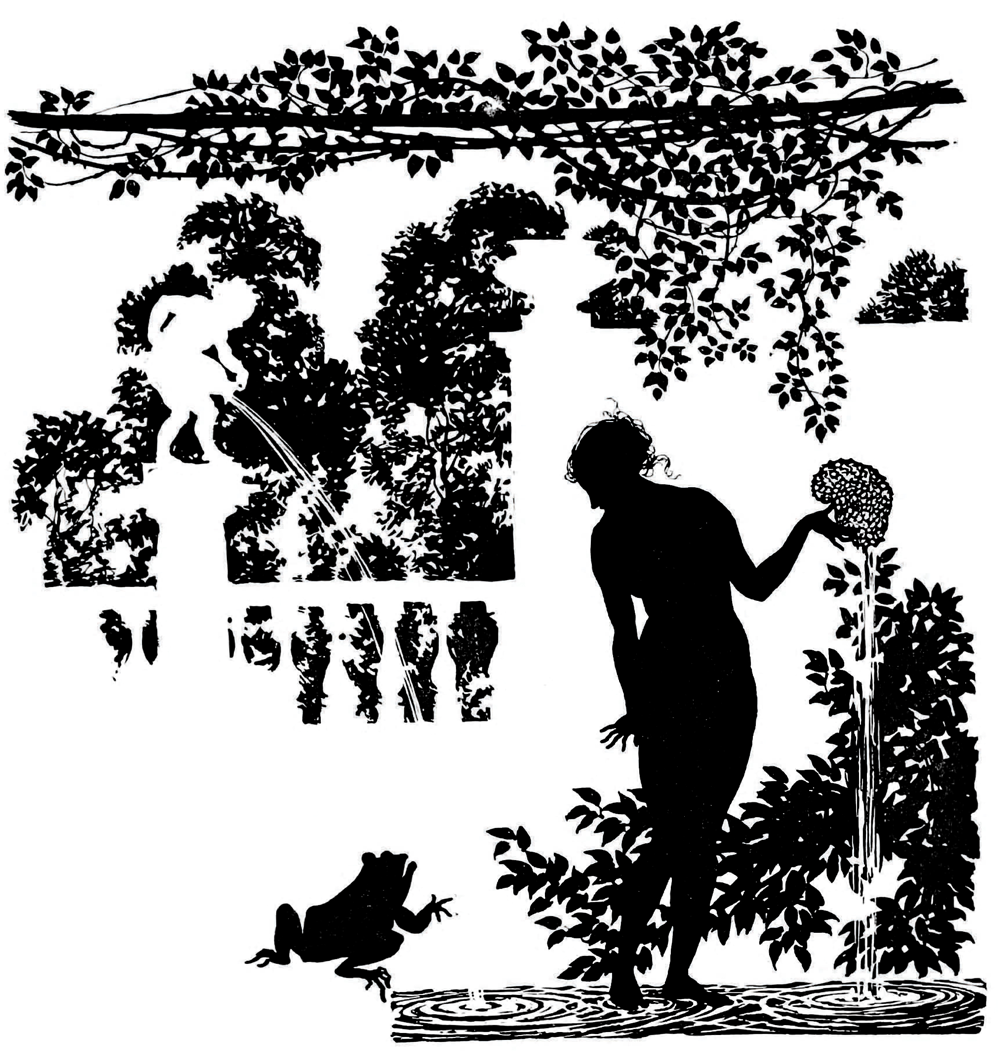
During the nineteenth century the cutting of silhouettes for portraits was a common simple method for capturing a likeness in profile. It was believed to be too limited a technique for full figure illustrations until Arthur Rackham proved otherwise. He developed black and white silhouette illustrations for Cinderella in 1919 and Sleeping beauty in 1920. The new technique made the books financially successful because they were cheaper than their colour-plate equivalents. Rackham’s clever use of negative space enabled a high degree of expression in his figures that told a story on a two-dimensional plane. The silhouette format and its elegant contours combine haunting humour with dream-like romance, a visual manifestation of the fairy tale genre. Intrigue draws the viewer in as the silhouettes leave much to the imagination.

Arthur Rackham, Illustration for Sleeping Beauty, 1920.
In a drawing Andy Warhol depicts both the three dimensional figure and the outline of its shadow. ‘The Shadow’ was one of several popular, American fictional characters that Warhol drew inspiration from for a series of prints called ‘Myths’ in 1981. This self-portrait drawing is based on a photograph of Warhol embodying the character, using strong lighting to cast a shadow of his profile on the wall behind him. He translated the photographic image into a simple, stylised line drawing. Once again the shadow creates mystery, as if symbolic of a hidden facet of his personality. By stripping the image down to line as opposed to a filled-in silhouette, Warhol plays with the confusion of positive and negative form, returning to the quintessential problem of art: perception.

Andy Warhol, The Shadow, 1981.
Anthony Gormley takes the mystery of the silhouette and turns it into an interactive experience in which the viewer also becomes the subject. ‘Blind Light’ is a brightly lit, glass walled room filled with mist. As figures enter the space they dissolve into the atmosphere. From the outside, anonymous shadowy figures are seen to emerge out of nowhere, coming into resolution only when they touch the walls. In this way, the walls act as the picture plane, with the figure becoming abstracted to the limits of readability as it moves away. This is the exaggerated effect of atmospheric perspective in action. It is another work which plays with perception, removing the viewer’s sense of location and knowledge of their surroundings as they themselves are reduced to a silhouette.

Anthony Gormley, Blind Light, 2007.