ART HISTORY TITBITS RELATING TO OUR WEEKLY THEMES - WRITTEN (unless specified) BY HAYLEY WHITTINGHAM
Hands/feet
After the face, hands and feet are the most expressive parts of the body. It may be tempting to shy away from drawing hands and feet as they present a technical challenge, but when their gesture is successfully captured, they are what gives a drawing its emotional power.
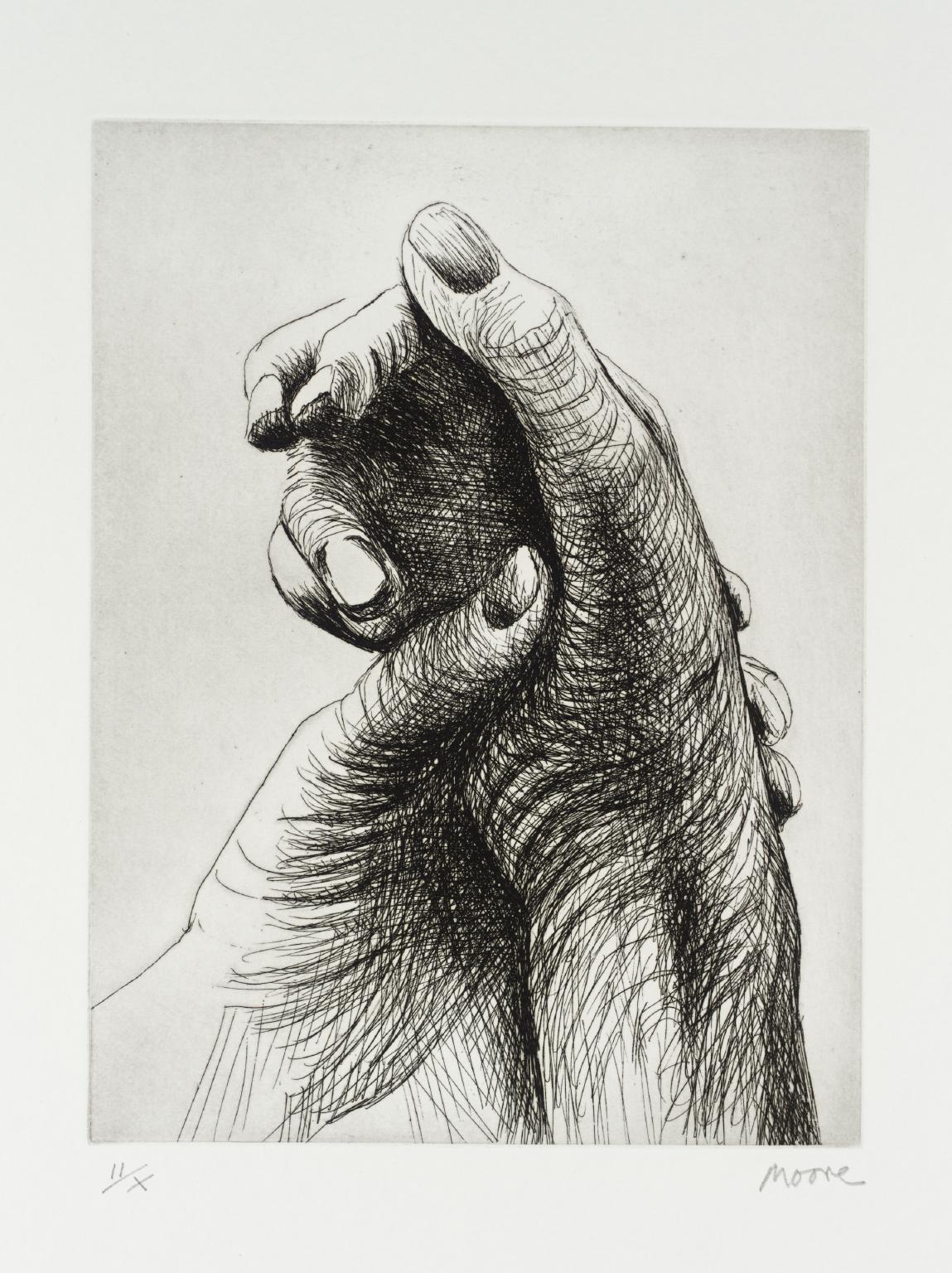
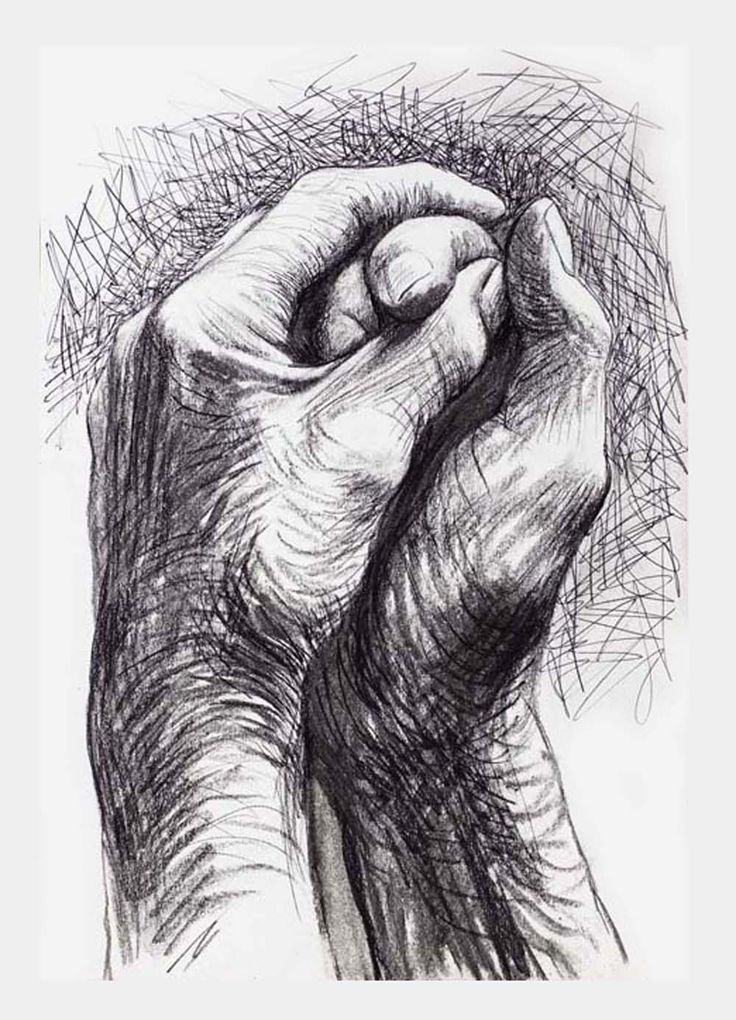
There is an infinite number of shapes a hand can make. Henry Moore made many drawings of his own hands in different configurations. He was interested in the hand’s ability to convey the emotions and the age of their owner, emphasised by directional shading. By letting go of the preconceived image of a hand, he was able to view them as simplified abstract shapes, leading to a more accurate drawing. It is rather ‘handy’ that we are able to draw our own hands and feet, offering a chance to become more acquainted with the forms before being faced with a life model in timed poses.
Whilst studying the hands and feet in isolation has many benefits, it is important to see them in integration with the rest of the figure, not glued on at the end! This helps keep proportions in check, demonstrated superbly by Euan Uglow. In many of his paintings the hands and feet are coming out towards the viewer, and scale is adjusted according to perspective, meaning that in this example one foot appears much larger and lower down in the picture than the other. Uglow uses the placement of feet firmly on the ground to situate the figure in space and give it weight.

Euan Uglow, The Quarry Pignano, 1979.
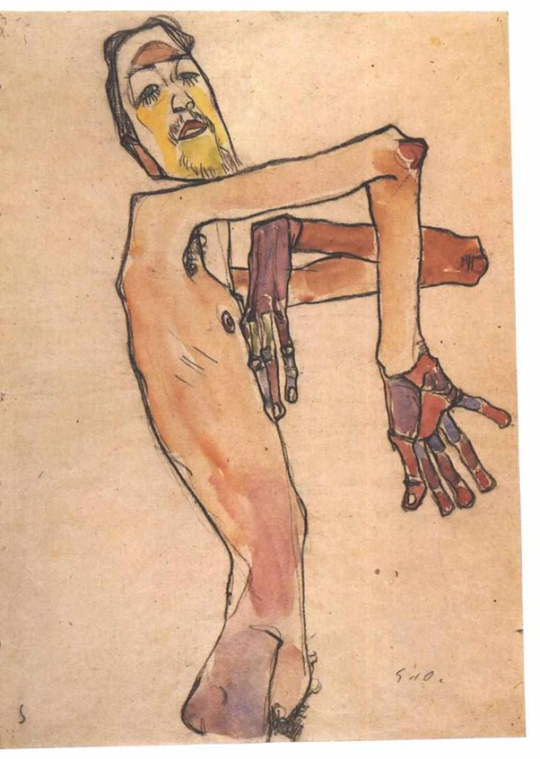
Egon Shiele takes a much looser approach to drawing hands and feet, exaggerating the gestures of his models through a strong line. The hands and feet of his nudes are not conventionally elegant but bony and spatulate. He depicts every articulation for maximum expression, embracing distortion literally from ‘head to toe’. It goes to show that drawings of hands and feet need not have perfect anatomical accuracy - but simply be executed with confidence!

Egon Schiele, Mime van Osen with crossed arms, 1910.
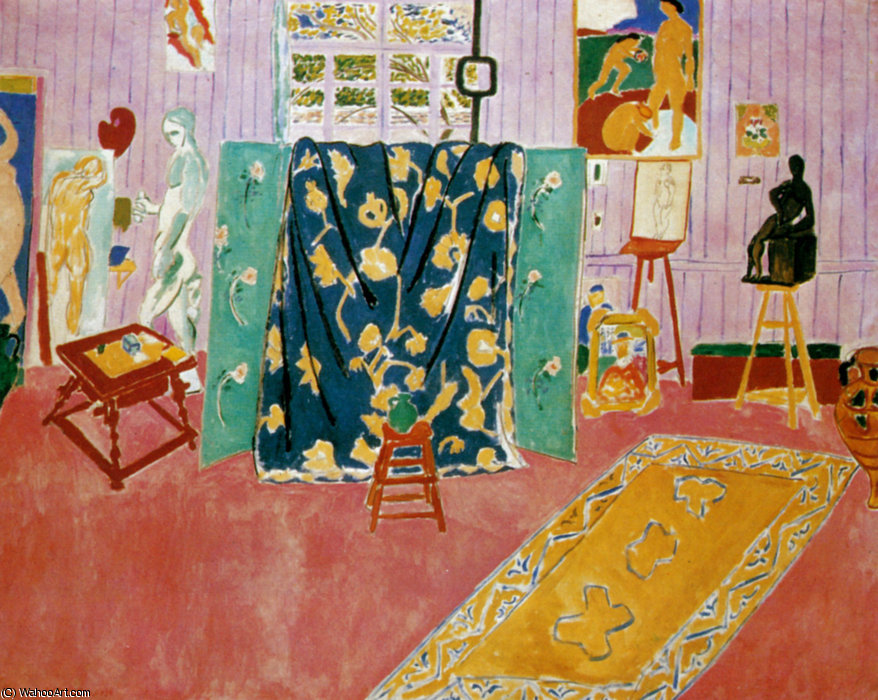
Matisse's studio
It is said that a visit to Matisse’s studio was like walking into one of his paintings. The interiors in his work are not invented, but a real self-contained world created by the artist in his own studio-home. Packed with ornate furniture, densely patterned textiles, vases and sculpture, it is no surprise that many of the objects in Matisse’s collection made their way into his painting. Just a small selection of them can be seen in ‘The Pink Studio’. Like many of his works, the title identifies colour as one of its subjects.

Matisse, ‘The Pink Studio’, 1911.
The nude figure fits into these elaborate ‘sets’ like any other object in the studio, challenging the convention that the human figure should be the focal point of the artwork. Whilst we may not think twice about placing a figure on an empty white page, Matisse believed that ‘the subject of a picture and its background have the same value … only the pattern is important.’ In this way, Matisse sought to express the full experience of his model’s session in the studio. For ‘Odalisque, Harmony in Red’, he created an arrangement of oriental patterned fabrics, and furniture, reminiscent of the Moorish interiors he had seen in Morocco. Like a continuation of his studio, he dressed his model in exotic jewellery and drapery which integrate her with the decorative surroundings.

Matisse, ‘Odalisque, Harmony in Red’, 1926
Matisse’s depiction of the female nude challenged traditional Western attitudes to the human form, overwriting naturalism (representation of the subject in a natural setting) and idealisation with the abstract language of African sculpture, of which he had at least twenty examples in his collection. This influence can be seen in the simplified, sculptural figure of ‘Pink Nude, Red interior’. Matisse believed that this new artistic language enabled him to express deeper and more enduring meanings about the body than conventional beauty.
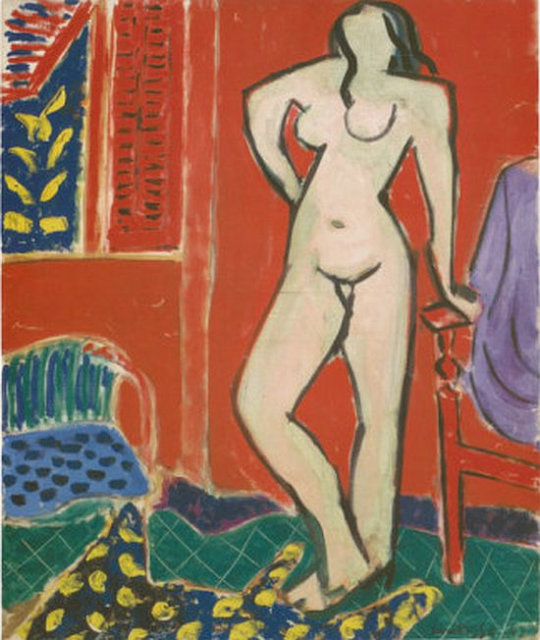
Matisse, ‘Pink Nude, Red Interior’, 1947.
Scale/perspective
Scale is always relative in a drawing – we rarely draw ‘to scale’. When reading an image, we rely on objects of known size to tell us how close we are. As we know, the further away something is, the smaller we should draw it, due to the laws of perspective. However these conventions can be manipulated in art, to fool the eye and create surreal compositions.
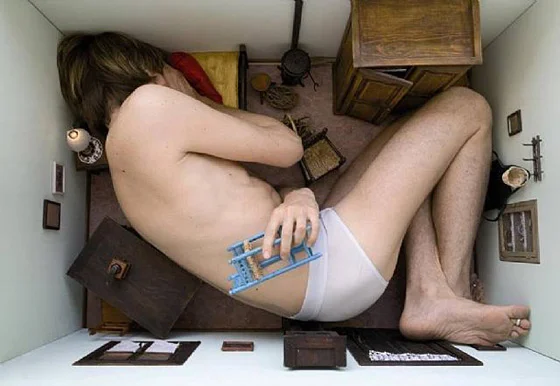
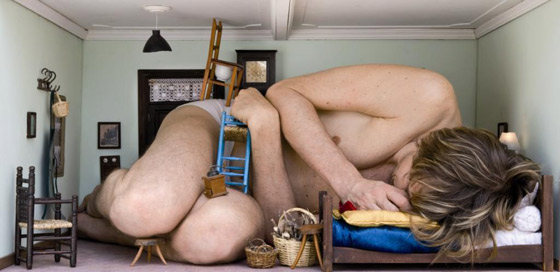
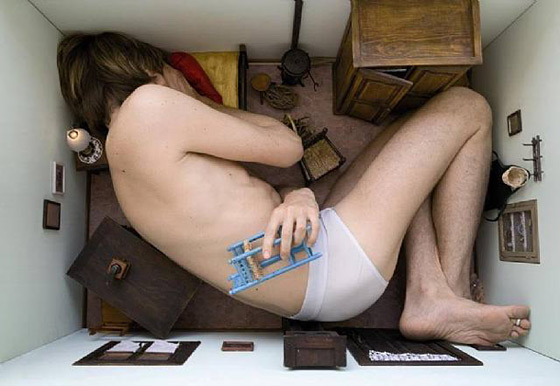
One artist who has played with this idea is Jean-Francois Fourtou in his 2007 series of sculpture and photographs ‘Mes Maisons’. We tend to judge the size of an object by the its relationship to the proportions of the body. As we grow, objects which appeared large to us as children may seem to have shrunk. Fourtou’s series is based on this sensation of the changing scale of his childhood bedroom. By creating a composition of everyday objects in miniature, he gives the impression that the figure is a giant, in an Alice in Wonderland scenario. Our eye is unable to determine whether it is the figure or the objects which are altered in size.
Miniature objects have the ability to draw us in or make us feel clumsy, whereas enlarged objects can overwhelm us and make us feel small. Marc Quinn makes sculptures of natural objects blown up to huge proportions, including five stainless steel shells. He used a 3d printer to create models of real shells before casting them. Model Natalie white posed nude within these sculptures, and the effect is a beautiful yet alarming sense of the vulnerability of the human body against nature.

Marc Quinn, ‘The Archaeology of Art’, 2011
Whilst these artists created elaborate sculptural pieces in order to alter our perception of scale, it is possible to achieve the same effect by much simpler means- a camera phone! Anyone who has visited the leaning tower of Pisa will be aware of the technique by which the image is flattened and objects in the foreground and background merge. By placing small objects closer to the lens, we can make them appear much larger in relation to the objects in the background, beautifully demonstrated by Kat to create the illusion of a flower-tutu.

Kat, 2017
These principles can be translated into life drawing – using careful placement of objects in relation to the figure, we can grow or shrink our model as desired!
Giacometti
Alberto Giacometti was a Swiss painter and Sculptor of the 20th century, whose striking, skinny figures are instantly recognisable. His career was characterised by obsession - He worked from the same studio for over 40 years, and could never be satisfied that a work was finished.
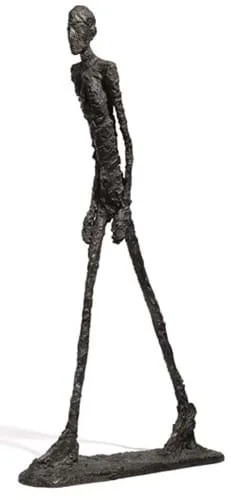
‘L’Homme qui marche I’ is one of Giacometti’s typical spindly figures who looks like he’s stepped straight out of a Tim Burton film. But there is a logic behind this extreme body shape. Giacometti was interested in the idea that it is impossible to view an object independently from the space that separates you from it. He aimed to accurately depict the impression of a body at a distance, disintegrating into the space that surrounds it, and reduced to its core like a tree that has lost its leaves. This tension between mass and space was a continuous subject of exploration in his work.

‘L’Homme qui Marche I’, 1961
Fun Fact: In 2010,’ this sculpture became one of the most expensive to ever be sold at auction, and currently appears on the 100 Swiss Franc banknote.
Many artists struggled to depict the subject of the human figure after the war. Giacometti had found an alternative to the anatomical or representational. His skeletal figures became associated with existentialist ideas and a sense of post-war trauma, as they seemed to epitomise the feelings of human exhaustion and guilt - easily understood when looking at works such as the monochromatic painting ‘Homme Debout’. The same spatial principles can be seen in this painting as his sculptural work.
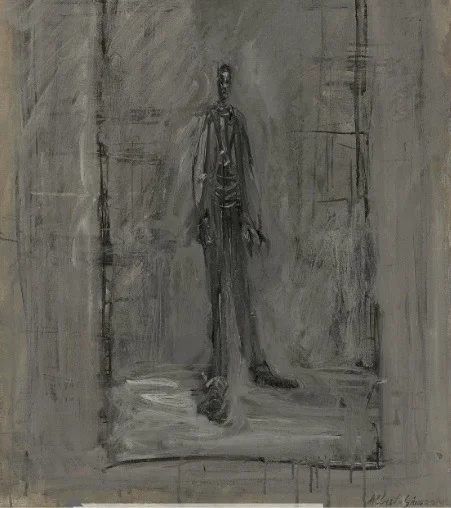
‘Homme Debout’, 1950
Giacometti did not exclusively work with the distant, skinny figure. He made many portraits too - whether from far away, or sitting close to his subject. He preferred to use models who he knew personally, which meant that his brother Diego was a recurring subject. Fascinated by the idea that life lies within the eyes, he concentrated on the sitter’s gaze, working all the other brushstrokes around this central point with a continuous scrutiny of his model. The results may not be flattering but there’s no denying their intensity.

’Head of Diego’, 1961
Dappled light
We may be used to drawing a model under a direct, uninterrupted light source, with the only shadows being those cast by the figure itself. However when other objects are introduced in front of the light source, the model will be adorned by interesting shadow shapes. The most everyday example of this is dappled sunlight coming through the canopy of a tree. The impressionists popularised painting ‘en plein air’ (outside) with a focus on the fleeting effects of light and shadow. This means the shadow shapes would be rapidly changing as they painted, especially in Scotland where you can never count on sunshine! Luckily for us, the effects of sun through foliage can be recreated in the studio with the benefit of a constant light source.
Most essential to representing shadows is tonal contrast. As seen in Anders Zorn’s ‘Nude under a spruce tree’ the shadows can be so large that you start to see light shapes rather than shadow shapes, in the form of chinks of sunlight hitting the body from one side. In this case it may be useful to work on a mid-toned paper so that areas of light can be picked out in white, and the paper left bare to represent the shadow colour, or shaded in black for a more dramatic contrast. The chiaroscuro of natural light seen in Zorn’s work gives an impression of immediacy and spontaneity, rather than that of a scene composed in the studio. Whilst this gives him an affinity with the impressionists, his figures are not just used to reflect the play of light but maintain a weight and corporeality absent from impressionist painting.

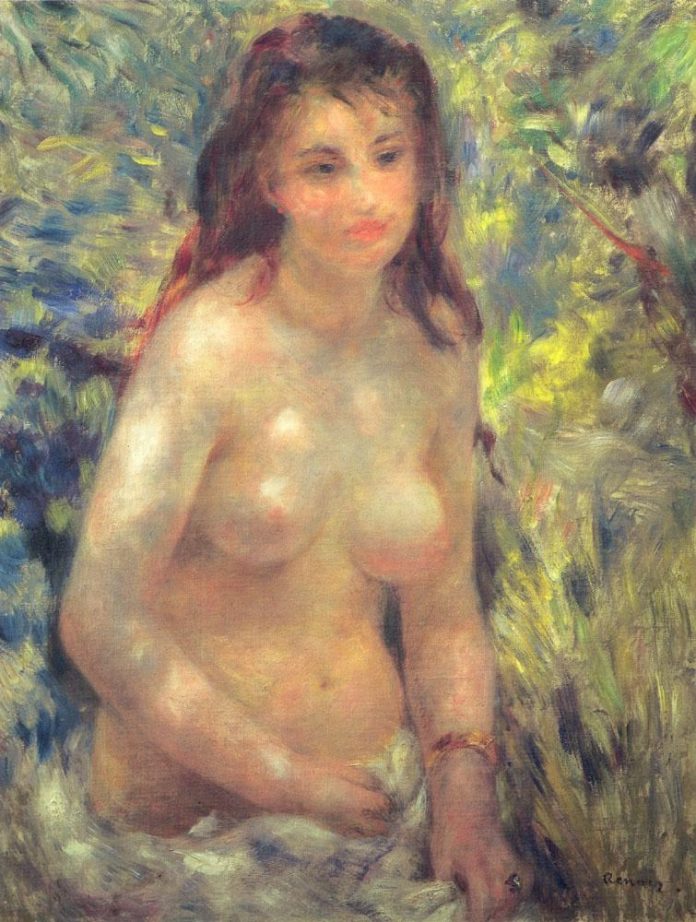
When working in colour like the impressionists, close observation of the shadows reveals that they contain a multitude of subtle colours. The impressionists rarely used black in their painting, creating softer shadows than those of Zorn. A fine example of this is Renoir’s ‘Torso, Sunlight effect’. He is quoted as saying “No shadow is black. It always has a colour. Nature knows only colours.” Following the theory of complimentary colours, he adds violet to his flesh tones for the shadows, the complementary of yellow sunlight. As a general rule, shadows contain cool colours whilst the highlights are made up of warmer hues. The deepest shadows, such as under the breasts and below the right arm, are tinged with green and purple. All this colour theory serves to capture the impression of dappled sunlight dancing across the skin.

Pierre-Auguste Renoir, ‘Study: Torso, Sunlight effect’, 1876
Light and shadow shapes follow the contours of the body and when drawn accurately can help to describe three-dimensional form. Take this advice from Monet; ‘Try to forget what objects you have before you. Merely think here is a little square of blue, here an oblong of pink, here a streak of yellow, and paint it just as it looks to you, the exact colour and shape until it gives you your own naïve impression of the scene before you.’ When Renoir’s nude in the sunlight was first viewed, and colour theory was relatively new, she was criticized for looking dead due to the blue-green patches on her body. To avoid your shadows looking like abstract tattoos or bruises on the skin it may be helpful to continue the shapes beyond the figure, onto the floor and walls around them. Julius Leblanc Stewart used this technique in ‘Sunlight’, painting pools of sparkling sunlight on the grass and tree trunks around his figures. This gives a suggestion of the material that the light is travelling through and unifies the scene.
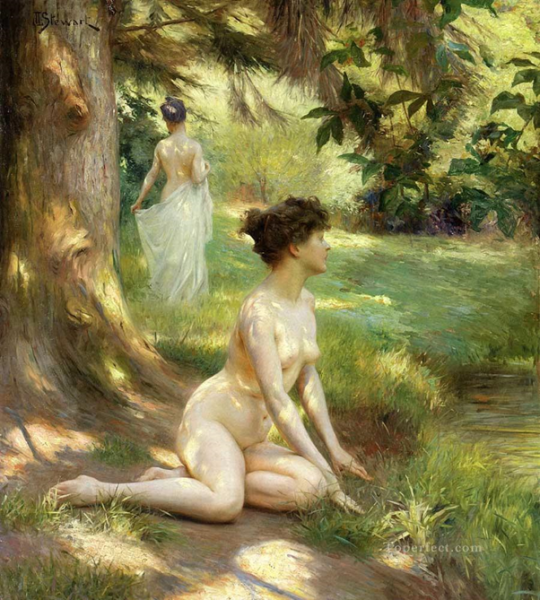
Julius Leblanc Stewart, ‘Sunlight’, 1919

![Getting [un]dressed](https://images.squarespace-cdn.com/content/v1/5c2034e75417fc423a175501/1546812354542-7HAONZ3KCRZYKTCSW109/Antoine+Watteau%2C+The+Toilette%2C+1717.%C2%A0.jpg)