ART HISTORY TITBITS RELATING TO OUR WEEKLY THEMES - WRITTEN (unless specified) BY HAYLEY WHITTINGHAM
Sun and rain
Romanticism in art was concerned with the power of nature – including the weather. This was encompassed in the concept of ‘the sublime’, literally meaning something that is ‘raised aloft’. It is so immense, whether physically or spiritually, that we can’t fully perceive or comprehend it. William Blake was a major figure of Romanticism in both poetry and art.
As well as British Romanticism, Japanese art and Haiku poetry commonly use the weather as a metaphor. Japanese artist Hiroshige has been referred to as “the poet of rain”. In Japanese culture the weather is considered it to be a clock that marks the milestones of life.
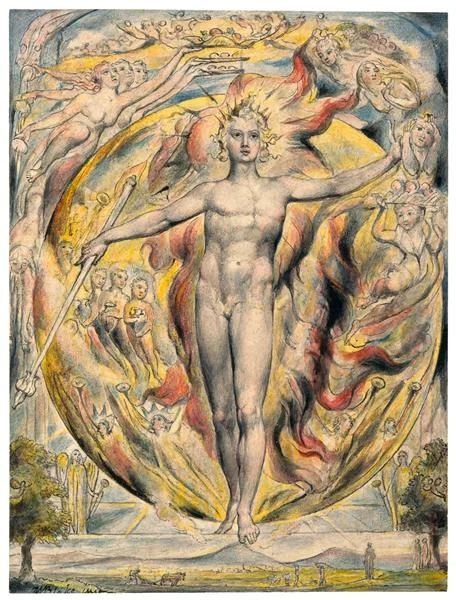
‘The Sun at his Eastern Gate’ is one of twelve watercolor designs by William Blake for John Milton’s poems L'Allegro and Il Penseroso, that contrast the cheerful man with the melancholic, thoughtful one. Blake was a poet himself as well as being an artist, and Milton was one of his inspirations. His work was probably inspired by the lines;
Right against the eastern gate,
Where the great Sun begins his state,
Rob’d in flames, and amber light,
The clouds in thousand liveries dight.
In Greek and Roman mythology, Apollo is considered to be the God of the sun, however Blake designed his own mythology in his artwork. His personification of the sun at his eastern gate may be read simply as sunrise, and the smaller figures behind him the clouds, carrying platters of food which celebrate the sun’s life-giving energy. However the outstretched arms of the sun and his sceptre suggest the more spiritual subject of the gates of heaven with throngs of angels rejoicing all around. The ‘flames and amber light’ of the poem give the painting its fiery colours - Blake’s interpretation of a heavenly light. Blake was interested in relationship between divinity and humanity. He claimed to have seen visions from a young age, usually of religious themes including God and angels. This visionary quality comes into his painting, and served as inspiration to British surrealist artist including Paul Nash and Graham Sutherland.

William Blake, The Sun at his Eastern Gate, 1820
Rain was a constant subject in Japanese Ukiyo-e (traditional woodblock prints and paintings). Whilst in British art the rain might be used as a metaphor for gloom and sadness, in Japanese art it is treated as a necessity and a blessing. Artworks depicting the rain served to represent gratitude. As seen in artistic renderings such as Harunobu Suzuki’s ‘Shrine Visit in Night Rain’, in Japan the sight of someone out in the rain without an umbrella is unusual. The rain itself is depicted with straight directional lines, in-keeping with the geometric simplicity of Ukiyo-e compositions. The direcitonality helps to suggest the wind along with the waving trees and ruffled skirt. The woman is struggling to hold onto her lantern at the same time as lifting her kimono to prevent it from getting wet.

Harunobu Suzuki, Shrine Visit in Night Rain, 1770
Pregnancy
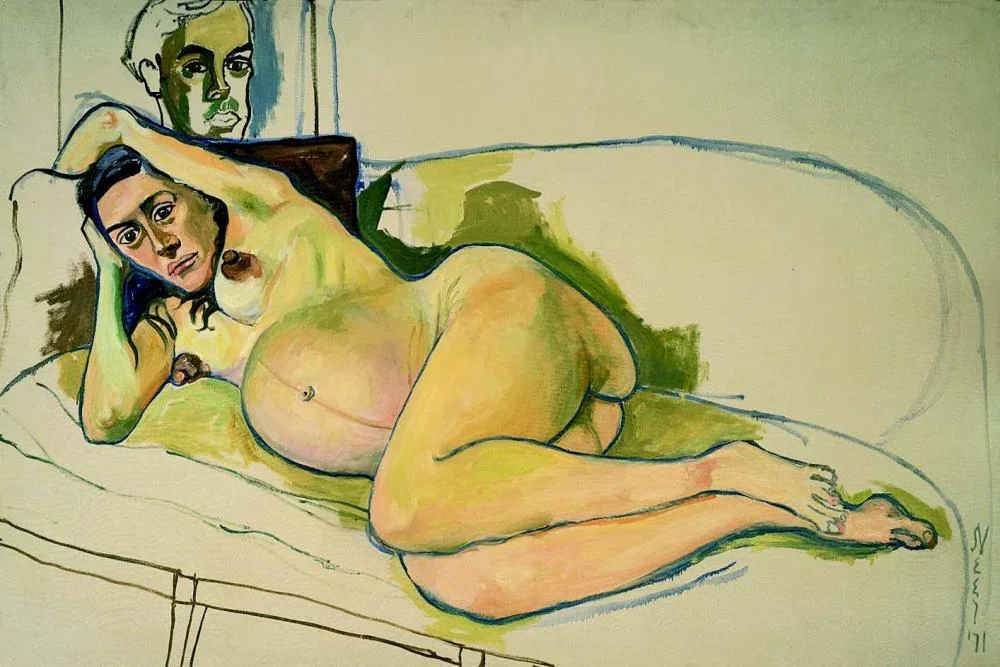
Imagery of the mother and child is commonplace in Western Art. However artist Alice Neel noted a striking inequality in the experiences represented. As a significant period in a woman’s life, she was amazed that pregnancy had been overlooked. In reaction to this she became one of several female artists who have more recently begun to create work inspired by their own experiences of being pregnant.
Gustave Klimt was one of the first artists to portray a nude pregnant woman in 1903. The work was not pre-planned but the result of one of his models, Herma, who failed to show up for one of their sessions. Klimt was concerned that she may be ill but received news that it was in fact because she was pregnant. He demanded that she model for him anyway, and upon seeing her decided to make her his model for the piece ‘Hope I’.
Although ‘Hope I’ may immediately appear to be an idealised image of a young pregnant woman wearing flowers in her hair, a closer look reveals otherwise. The background is made up of Klimt’s characteristic art nouveau shapes – or figures, which bear the faces of disease, old age and madness, as well as a skull positioned directly above the head of the young woman. These morbid undertones may have a biographical significance to the artist. One year previously, Kilmt’s son Otto had died in infancy. His original sketch for the painting featured a male companion comforting the woman. It has been suggested that the death of Klimt’s son caused him to alter the mood of the painting, turning it into a memento mori or expression of hope for new life in the face of death.

Gustave Klimt, Hope I, 1903.
It could be said that Klimt eroticised his models, as is conventional for nude women in Western art. Alice Neel plays with the perceived incompatibility between the erotic and the pregnant body, which she sees as an important but neglected fact of life. She painted several of her pregnant friends in traditionally erotic poses found in mass media photography and rooted in art history. Her work challenges the historical tendency of male artists to shy away from pregnant women due to false modesty or for want of a more sexually available subject. She says “A pregnant woman has a claim staked out; she is not for sale.” Her paintings defy the polarisation of women into the chaste ideal or the dangerous whore. They are a reminder that an ordinary “good” woman can also be a sexual being. If they appear unusual, this is only evidence of the degree to which society still glosses over the basic truths of a woman’s sexuality.
The focus given to the pregnant belly as container may seem to objectify and diminish the individual identity of the sitter. Nancy, Neel’s daughter-in-law, recalled a conversation in which Neel shared her opinion on late pregnancy, “Your body ceases to be your own. You become a vessel. At a certain point you lose your self-image.” In this way she subjects her sitters to particular form of objectification, in a sympathetic reflection of her own experiences. Despite this she does not generalise or romanticise them, acknowledging the unique experiences of each woman.

Alice Neel, Pregnant Woman, 1971.
Jenny Saville is another female artist who produced a group of large-scale works that intimately portray pregnancy and motherhood. After giving birth to her son in 2007, followed by a daughter in 2008, her work naturally turned to the expression of her personal experience as a mother. She explained ‘I’ve spent most of my life trying to paint flesh; and when I was pregnant, the experience of growing flesh and giving birth felt very profound to me. I felt like I gained a different level of understanding in terms of painting and drawing bodies, so I had to do something with that.”
Saville recorded her own pregnancies in paintings and drawings, as well as inviting other expectant mothers to model for her. She observed that women were often more open to the idea of posing nude whilst pregnant, as it is the one time that it’s socially acceptable to be ‘rotund’. Drawing upon this, she was keen to avoid sentimentalising her subject. Whilst she was compositionally inspired by Leonardo da Vinci’s Virgin and Child, its serenity is replaced by an intense dose of reality. A tangle of body parts, large and small, are depicted in a pattern of chaotic brushstrokes. The mother appears exhausted, a wriggling child under each arm, one of whom is doing his best to escape. Far from a sentimentalised Madonna, this is woman ‘at human capacity’. As well as truthfully representing her subject, Saville manages to successfully convey the feeling of trying to paint whilst bringing up young children.
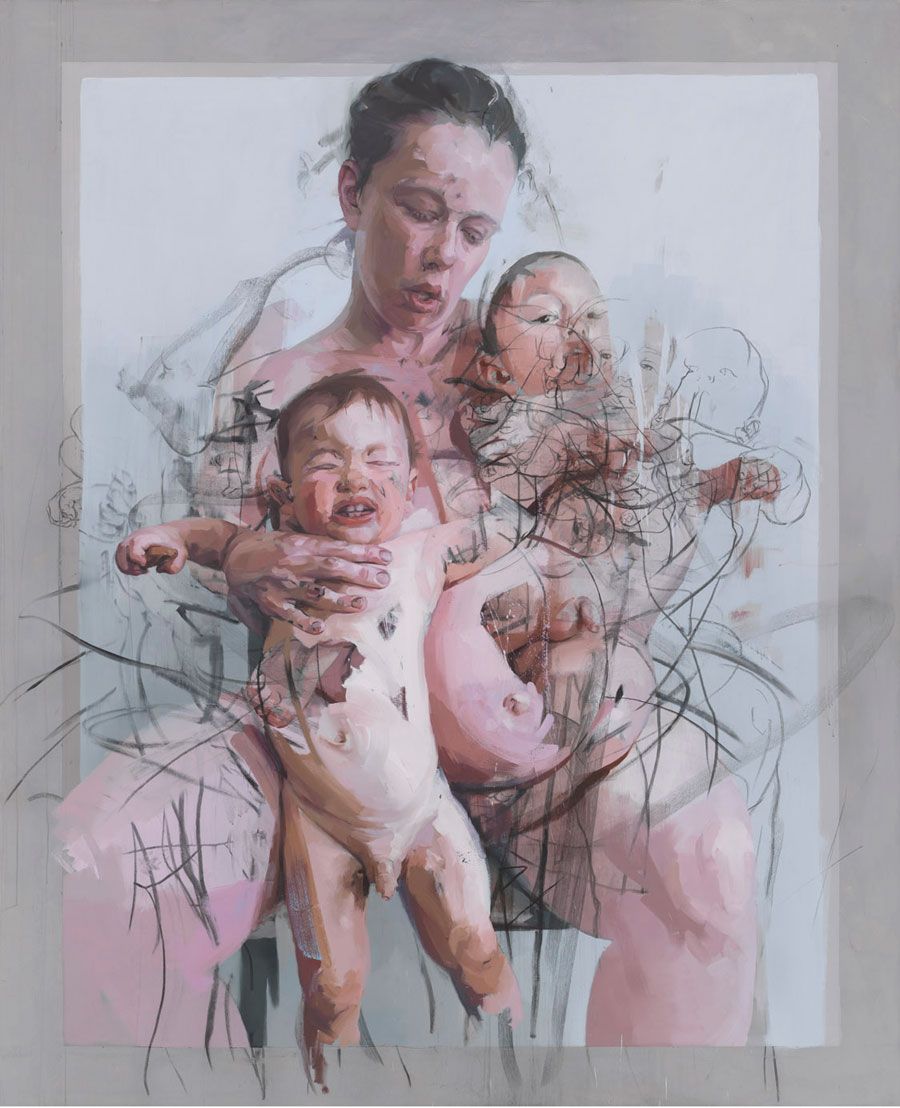
Jenny Saville, Mother and Children, 2011.
Narrative
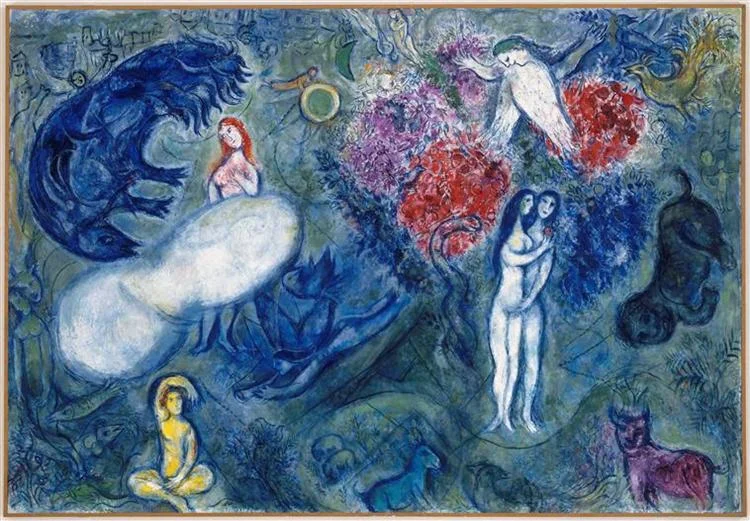
Chagall’s ‘Le Paradis’ and Jacopo del Sellaio’s ‘Cupid and Psyche’ represent two different approaches to depicting well known narratives in a single work of art. Each tackles the issue of space differently, and uses a range of pictorial devices to communicate a story in the absence of words.
Chagall’s ‘Le Paradis’ depicts Adam and Eve in Paradise – an indeterminate space made up of layers of colour. The figures are represented multiple times, beginning with the birth of Adam on the right and Eve on the left, followed by the two embracing as Eve offers Adam the fruit. The narrative features of the painting are not depicted literally but symbolically. Sea creatures, land mammals and birds occupy a unified picture plane, alluding to the story of creation, and the harmony of all God’s creatures. The symbols of serpent and fruit tell us that this is the moment before the fall. Despite these clues the narrative remains vague enough that it is left up to the viewer to decide whether this is a moment of sharing embrace, or rebellion against God. This element of mystery is created by Chagall’s dreamlike interpretation of biblical stories.

Marc Chagall, ‘Le Paradis’, 1961.
Jacopo del Sellaio depicts another well-known story – that of Cupid and Psche - all on a single panel painting. Unlike Chagall’s dreamlike space, it is clear how this painting is intended to be read. The narrative unfolds from left to right, a bit like a comic strip. The fall of light and the direction of the grass help to point the way for the viewer. Psyche features in the painting fifteen times. If it wasn’t for the identifying clothing which remains the same for each character throughout their many appearances, the complicated narrative would be impossible to follow.

Jacopo Del Sellaio, 'Cupid and Psyche’, 1473.
The painting begins on the far left with Psyche’s conception in the bedchamber of Endelechia, followed by her birth below. As she leaves the house, now a woman, she is met by a crowd of male suitors. Cupid is seen hovering above, following the orders of the jealous Venus to put a curse on Psyche, but falls in love with her himself. In the distance her parents take her to visit the Oracle of Apollo in order to find a husband. On hearing that she’s cursed to fall in love with a monster they send her to the top of the mountain, where she is pictured consequently being blown down by the wind. She is then welcomed into the palace of cupid, who makes her his wife but prohibits her from setting eyes on him. Outside the palace she chats with her sisters who persuade her to break the vow out of suspicion. Finally, inside the bedchamber she lights a lamp to gaze upon him whilst he sleeps, accidentally waking him, and he flies away from her out of the top right corner.
The story has a clear beginning and end, symbolically bookended by the two bed chamber scenes. The painting covers a large span of psyche’s life in a single unified landscape, which calls for the extended length of the panel. Gestures and facial expressions are also used to convey the narrative in the place of words. It is likely that the contemporary audience would have found the act of deciphering such a narrative painting a form of social entertainment and an opportunity to show off their knowledge of literature and mythology. The painting would have originally decorated an Italian marriage chest, in which context the narrative would have served as a call for obedience in marriage directed at wives.
Masks
Masks have made an appearance in various artistic movements. They are full of ambiguity – is it a figment of the artists imagination or is the sitter wearing a mask? They were a trope of decadence, a late 19th century artistic movement characterised by excess and artificiality, a critique of the ‘sickness’ of society. Decadent writer Arthur Breisky wrote ‘isn’t it necessary to believe a beautiful mask more than reality’

Aubrey Beardsley, The Scarlet Pastorale, 1896.
Belgian painter James Ensor’s work is known for groups of masked figures, reflecting the carnival traditions of Belgium and the Netherlands. He worked in the attic of his mother’s souvenir shop surrounded by masks and costumes from the stock. Whilst the mask is often worn to conceal identity, for Ensor it had a much greater potential. He exploited its anonymity to transform reality into the strange and unsettling. Ensor’s distorted masks reveal the true character of their wearer as malicious and superficial – satirising public figures and challenging religion and politics. The crowd depicted in ‘The Entry of Christ into Brussels’ is a combination of bourgeoisie, clergy, and the military. The mask may be a metaphor for the solitude of the individual in the increasing masses of society. They mingle with clowns and skulls, both dehumanised and threatening. Garish colours give the scene an otherworldliness and bring it into the realm of symbolism.

James Ensor, The Entry of Christ into Brussels, 1889
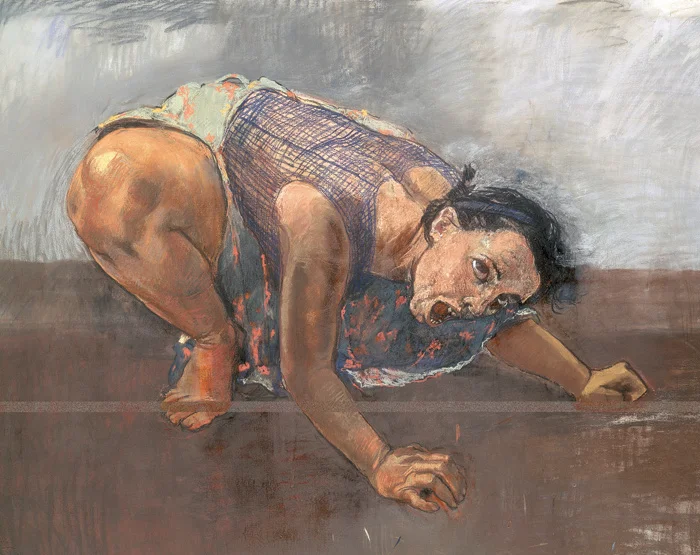
Paula Rego often works with masks, paper mache dolls and stuffed toy animals, using them to tell stories in her paintings. The use of props such as masks reveals the constructed artificiality of her imaginative world, suggesting it is in fact closer to reality than we think. This is demonstrated by her painting ‘War’, which features several figures wearing rabbit masks. Rego says the work is a response to a photograph she saw in the Guardian of a screaming girl in a white dress running from an explosion in the Iraq War, while a woman and a baby stand on the spot behind her. Rego explained, ‘I thought I would do a picture about these children getting hurt, but I turned them into rabbits’ heads, like masks. It’s very difficult to do it with humans, it doesn’t get the same kind of feel at all. It seemed more real to transform them into creatures’. The masks may give the scene more impact by making it relatable, as the figures could stand for anyone. Art historian Philippe Dagen compared ‘War’ to a child’s nightmare generated by books or films, which ‘instantly perverts its previously happy and warm world’. The resemblance of the masks to children’s toys - made grotesque -enhance their nightmarish qualities.

Paula Rego, War, 2003
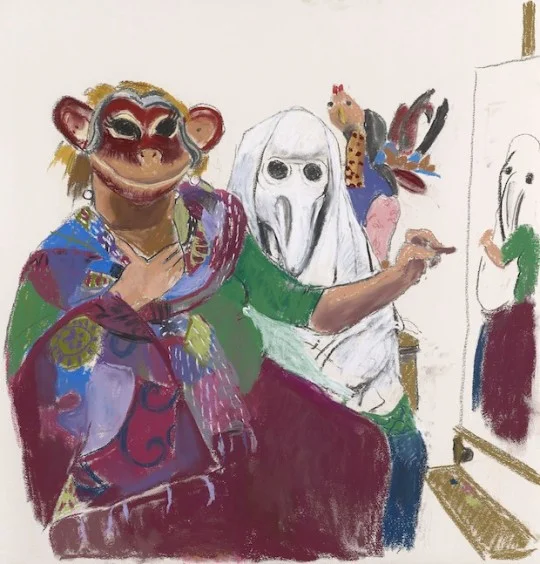
Paula Rego also painted self portraits whilst wearing a mask. It is important that her portraits are completed from observation, using props, rather than being from imagination. This creates a confusion between reality and artifice, adding to their strangeness. It may be a comment on the inescapable artifice of art.

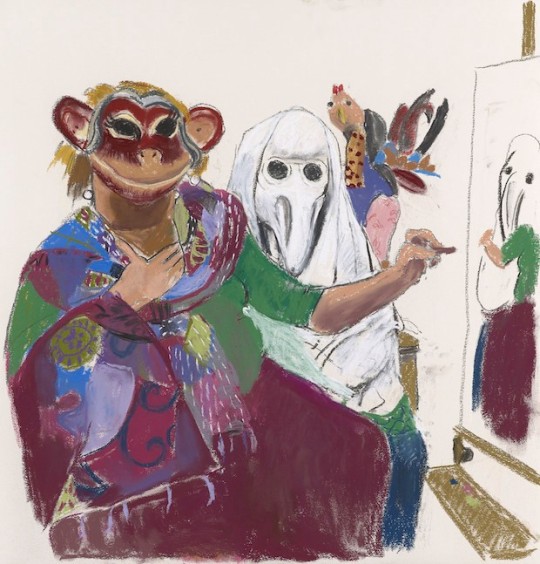
(Paula Rego painting herself wearing a mask)
The familiar
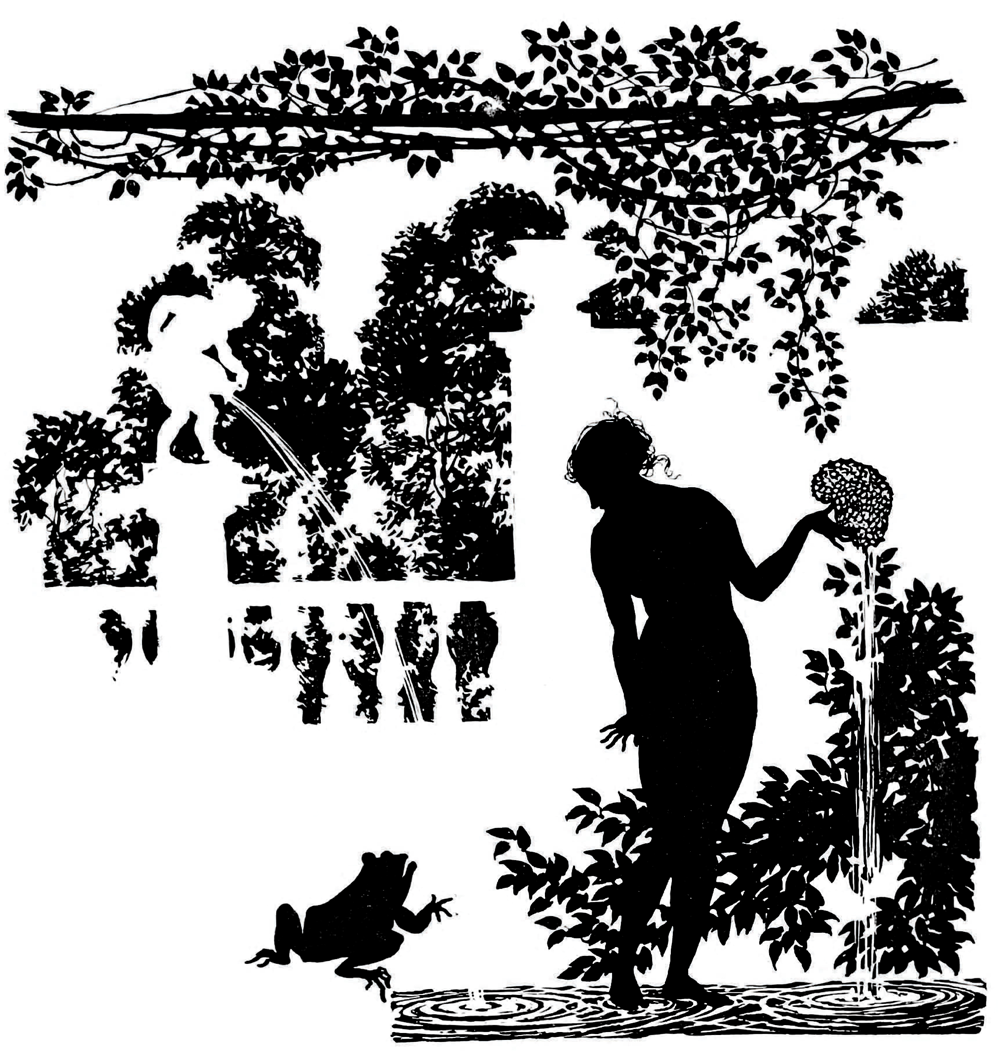
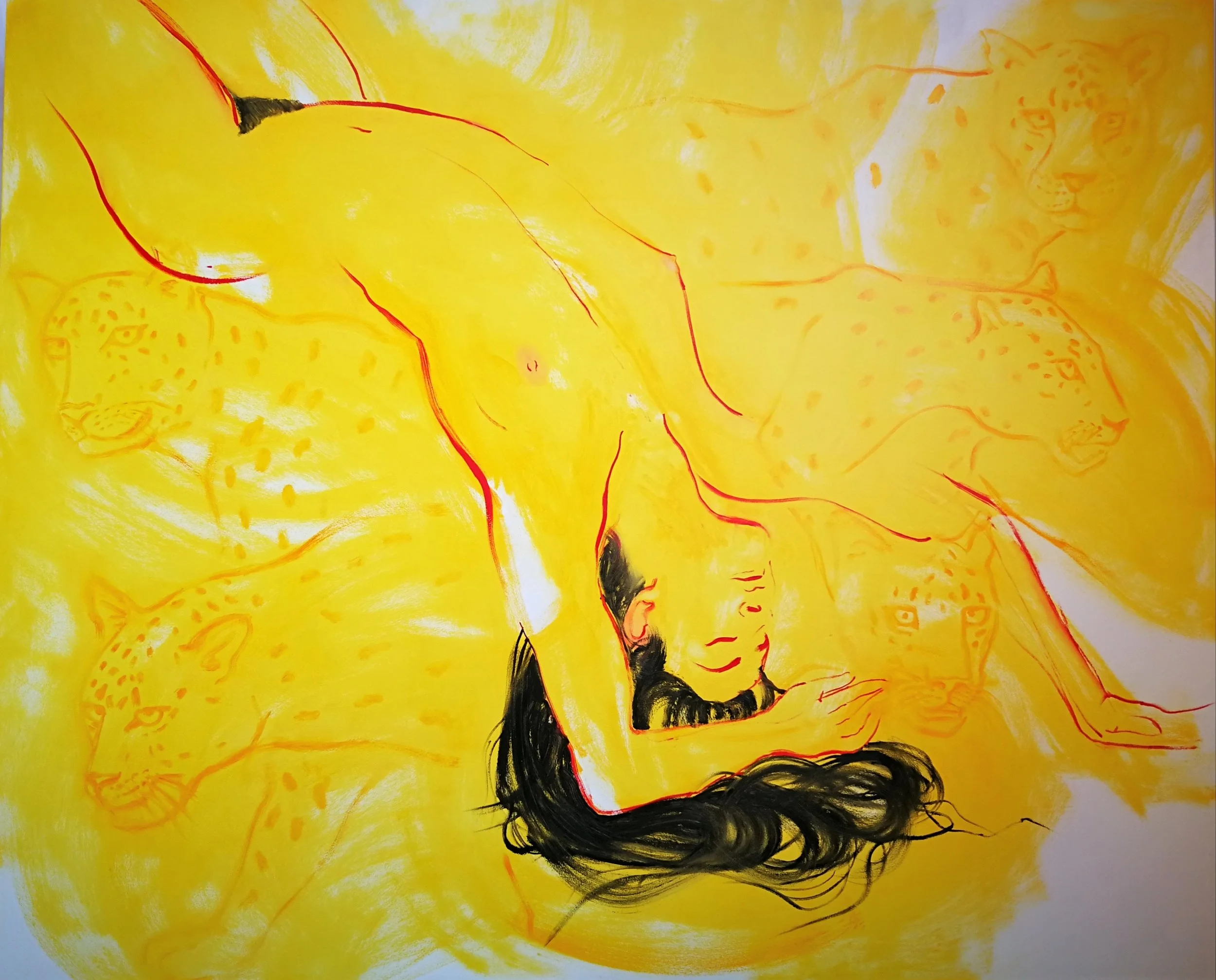
In European folklore the ‘familiar’ is a supernatural being that would act as a witch’s assistant, providing a young witch with protection as she came into her powers. They often took the form of an animal - most commonly small animals, such as cats, rats, birds, toads, and hares. The familiar could be compared to an alter-ego, not resembling the witch, and sometimes even invisible. The motif has found its way into fairy tales such as Puss-in-Boots and the Frog Prince. Women and animals are also often shown together in art, recalling the close ties of the witch and her familiar.

John Collier, Lilith, 1887
John Collier painted Lilith –the Jewish mythological figure and first wife of Adam in the bible - in the style of the pre-Raphaelites. Over the years Lilith has gained a reputation as a femme fatale, having been cast out from Eden for her disobedience. Here she is shown entwined with a serpent, maybe representative of that which tempted eve to eat the forbidden fruit. The close embrace suggests that the serpent is also symbolic of a part of her nature, like a spirit animal. In Michelangelo’s ‘Fall of Man’, he took this one step further, representing Lilith as a snake/human hybrid.

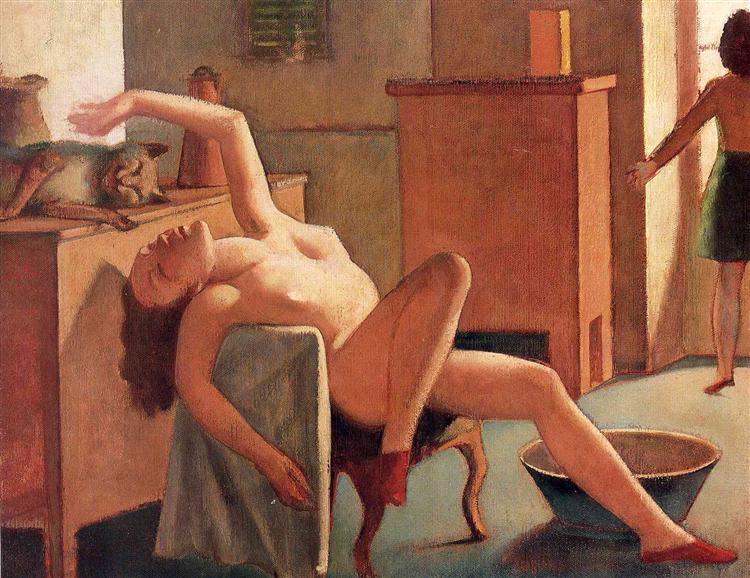
Balthus, Nude with cat, 1949.
A nude girl reclines over the back of a chair with her eyes closed, playing with a grinning cat. The relationship appears natural – both creatures are completely comfortable in the presence of the other. The interior is sparsely furnished, like a stage set for the interaction to play out. Animals are often featured in art for symbolic meaning – relating to the inner qualities of the person beside whom they are depicted. In Balthus’s work, cats are contrasted with supposed feminine innocence, possibly standing in for the artist himself. As an animal they are associated with self-absorbtion and trickery. There is a traditional symbolism tied to many other animals as follows:
Dogs – fidelity
Snakes – the fall of man
Toad/frogs – shape shifting, fertility
Crows- adultery/betrayal
Doves – innocence/peace
Lions – power, wisdom, dignity
Fish - death, destruction, cunning, sinfulness
Foxes - Cunning, intelligence, feminine magic, wildness
Sometimes the link between human and animal in art is so strong that the two merge to become one hybrid creature – as found in mythology. The woman-animal combination is often associated with the femme fatale, suggesting that animalistic features were seen as the antithesis of the appropriate behaviour expected of a woman, and a threat to order.

John William Waterhouse, A Mermaid, 1900.
John William Waterhouse was interested in the darker mythology of the mermaid – a siren who was said to lure sailors to their death through their singing. This mythology corresponds to the symbolism of the fish. His mermaid’s tail ids painted with shimmering silver scales suggesting observation from a real fish. Having a tail in the place of human legs means mermaids would be incapable of living amongst men. Waterhouse’s imagining of the mermaid focuses more on this aspect of tragic loneliness and isolation. She sits on a rock gazing off into the distance whilst combing out her long hair.

Gustave Moreau, Oedipus and the Sphinx, 1864.
Gustave Moreau’s Oedipus and the Sphinx features the hybrid creature from Greek mythology with the head of a nude woman, lion’s body and vulture’s wings. She grips onto Oedipus with lion’s claws yet looks into his eyes with those of a woman. These features characterise the sphinx according to its merciless reputation. It may be seen as a form of femme fatale – combining the power and wisdom of a lion with the greed, corruption and ruthlessness of the vulture.

![Getting [un]dressed](https://images.squarespace-cdn.com/content/v1/5c2034e75417fc423a175501/1546812354542-7HAONZ3KCRZYKTCSW109/Antoine+Watteau%2C+The+Toilette%2C+1717.%C2%A0.jpg)