ART HISTORY TITBITS RELATING TO OUR WEEKLY THEMES - WRITTEN (unless specified) BY HAYLEY WHITTINGHAM
Dance
Diaghilev’s Ballets Russes were taking France by storm in 1909-11. With their music movement and colour they were ‘a total work of art’ which broke free from the codes of classical dance. This new perspective on ballet may be what stimulated the growing interest of painters and sculptors who took it as their subject. Isadora Duncan’s pioneering dance style based on natural movement reflected increasing freedom in the arts. In the context of such developments, links between art and dance were strengthened, with a shared taste for rhythm and the primitive. The new styles of dance were particularly suited to artists working from life, as unlike classical ballet, the poses and movements were natural and unpredictable.
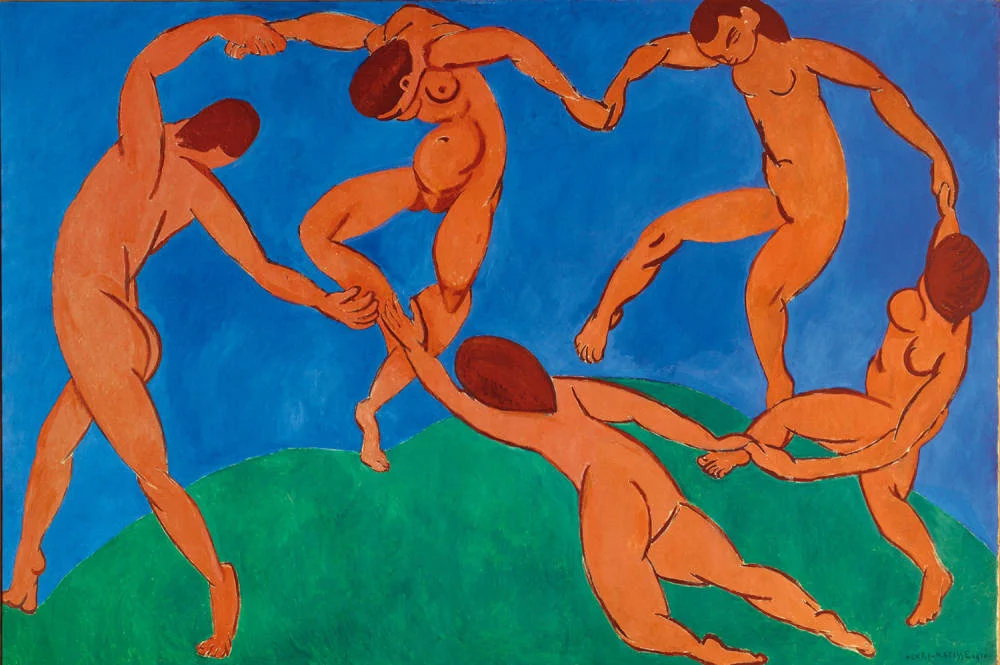
Matisse’s painting ‘La Danse’ is often associated with ‘The Dance of the Young Girls’ from Stravinsky’s ‘The Rite of Spring’, written for the Ballets Russes. The composition or arrangement of dancing figures is reminiscent of William Blake’s watercolour “Oberon, Titania and Puck with fairies dancing” from 1786. It was painted with a companion piece ‘Music’ and originally hung together, comprising the two main elements of Ballet. It features five muscular dancing figures in red against a simplified blue and green landscape. The simple style and strong contours reflect Matisse’s interest in primitive art whilst using a fauvist colour palette of intense red figures against a cool background. Form matches content – the rhythmical pattern of nudes dancing in a circle conveys feelings of emotional liberation and hedonism. With hands linked, they are swept off their feet giving an impression of momentum. There is only a slight break in the circle between the hands of the two foremost dancers, creating a sense of tension but also an invitation for the viewer to join in.

Mastisse, La Danse, 1910
Like Matisse, J.D Fergusson depicts a group of nudes dancing in a stylised landscape, titled ‘Les Eus’. This time the figures are more densely layered and include male as well as female dancers. Their free rhythmic actions also correspond with the new dance style of Isadora Duncan and the Ballets Russes. Fergusson moved to Paris in 1907 for the artistic stimulation which Scoltand couldn’t offer him. Whilst there he absorbed the new ways of looking at the world pioneered by French artists like Matisse and Cezanne, and would have seen Matisse’s ‘La Danse’ at the 1910 Salon d’Automne. His interest in the subject of dance grew when he began to receive free tickets to the Ballets Russes and regularly sketched the dancers there.
His use of bold line and strong tonal contrasts emphasise pattern whilst supressing depth. A sense of rhythm is created by repetition of the curved lines of the dancers in the surrounding foliage. The title is believed to have come from the term “Eurythmics”, coined by Emil-Jacques Delacroze in 1911 for his new science of dance. The Eurhythmics movement emphasised the relationship between dance and health, and promoted the understanding of music through physical movement. It was highly influential on Fergusson and his work.

J.D. Fergusson, Les Eus, 1911-13
Henri Gaudier-Brzeska was a French artist and sculptor living and working in London from 1911-14. Like Matisse and Fergusson, it is likely that Gaudier’s innovative translation of movement in his sculpture ‘Dancer’ was influenced by the liberations taking place in contemporary dance. Gaudier found inspiration from the Ballets Russes when they came to London. He worked closely from his friend and model Nina Hamnett. Although the proportions of Dancer appear to have been manipulated, observation from life is seen in the otherwise anatomically correct pose and sensitive modelling of the muscle and bone structure. She is poised in dance with her hands above her head, legs bent as if dismounting her plinth.
Rodin’s ‘Dance Movements’ are a likely source for Gaudier’s conception of Dancer. Gaudier took many of his ideas about what sculpture should achieve from Rodin’s book L'Art, which promoted the goal of capturing life through movement. Rodin’s words are echoed in Gaudier’s own expression that 'Movement is the translation of life and if art depicts life, movement should come into art, since we are only aware of life because it moves’. In imitation of Rodin, Gaudier said he wanted ‘a model who didn’t pose at all, but did everything he wanted to, walked, ran, danced’. He fulfilled this desire when sculpting Dancer, with his request that Hamnett 'turned around slowly’ whilst he worked. Dancer captures a paused moment, where the twisted tension of the body anticipates a release of energy. The elongation of the limbs and sinuous form modelled in clay add to the sense of fluid movement.

Henri Gaudier-Brzeska, Dancer, 1913
Fruit
Still life was at the bottom of the hierarchy of genres during the renaissance. Artists would sometimes justify a fruit bowl still life through the inclusion of a nude, or by creating visual puns from the symbolism. Some highlighted the erotic associations of certain fruits, with their anthropomorphic shapes. The associations between fruit and sensuality come from the notion of the forbidden fruit, and fruit’s fertile, tactile nature. Like the human figure, fruits were seen as one of God’s creations deserving of representation. Still lifes of fruit bowls could be used to balance out a figure composition and demonstrate the broad range of the artist’s skill in tackling multiple genres in the same work.
Caravaggio was one painter known to use fruits as sexual metaphor. He painted over a dozen pictures containing seventeen different fruits and vegetables. In his ‘Bacchus’ an effeminate young boy with a grapevine in his hair offers out a goblet of red wine. This is quite literal symbolism for Bacchus who was the God of wine, madness and ecstasy. In front of him is a basket of fruit, some ripe and some rotting, leading it to be interpreted as a vanitas – a type of still life common in the renaissance and baroque periods intended to remind the viewer of the fleeting nature of earthly life. Like his figures, Caravaggio painted the fruits from life, including precise representations of disease symptoms and insect damage. One of the vine leaves on his head is turning red, probably an indication of crown gall, a bacterial disease causing swellings on stems and roots. There may be a simpler explanation for the inclusion of rotting fruit, as painting such precise detail would have been a timely process. The fruits include black, red, and white bunches of grapes; a bursting pomegranate, figs, a large green pear, three apples and a half-rotten quince. Whilst some interpret the bursting pomegranate as sexual metaphor, others argue that he was simply displaying his painterly skill, and his love of the shapes and lushness of the fruit.
Any erotic overtones are heightened by Bacchus’ fingering of his loosely draped robe, as he appears to be inviting the viewer to join him with the offer of wine. Upon closer inspection the façade of the Greek God gives way to the reality of a half-drunk teenager with a men’s shirt slung over his shoulder, resting against a grubby mattress in the studio. It has also been discovered that Caravaggio included a miniature self portrait of himself painting his subject in the reflection of the wine glass.

Caravaggio, Bacchus, 1595.
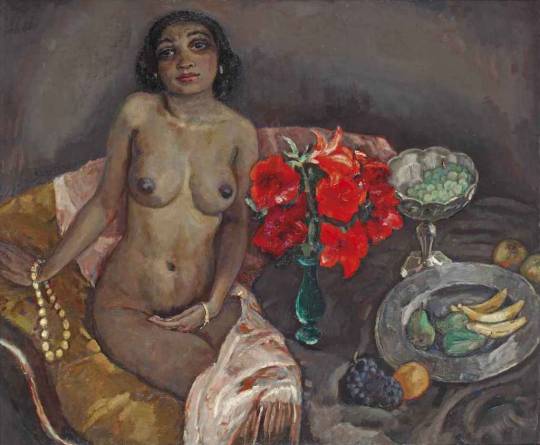
Jan Sluitjers often painted female nudes accompanied by still lifes such as flowers and fruit bowls. These fruit bowls are positioned to the side, in front and behind the model. In both ‘Seated nude with flowers and fruit’ and ‘Still life with standing nude’, the fruit rests on an abundance of crumpled coloured drapes, which continue over the nude’s shoulder and leg, turning her into a part of the still life. Whilst Caravaggio’s ‘Bacchus’ is primarily a painting of the Greek God, adorned by fruit, the fruit and figures in Sluitjers’ paintings are invested with equal significance. It is possible that the artist was drawing parallels between women and fruit, a theory supported by the feminine forms of the various vases and vessels alongside the pears in ‘Still life with standing nude’. The upright vase is a definite echo of the shape of the standing nude, which in turn echoes the pear. Decorative porcelain fruit bowls, as well as the jewellery in ‘Seated nude with flowers and fruits’ suggest the exotic spoils of geographic expansion. Unlike Caravaggio’s fruit, the fruit here all appears to be fresh and ripe, standing as a symbol of female fertility, youth and vitality. However like youthful beauty, we are aware that the fruit is perishable and ephemeral. As the apple is associated with the Tree of Knowledge and the Garden of Eden, the female nude alongside the apple may be a reference to Eve and the notions of temptation and sin.
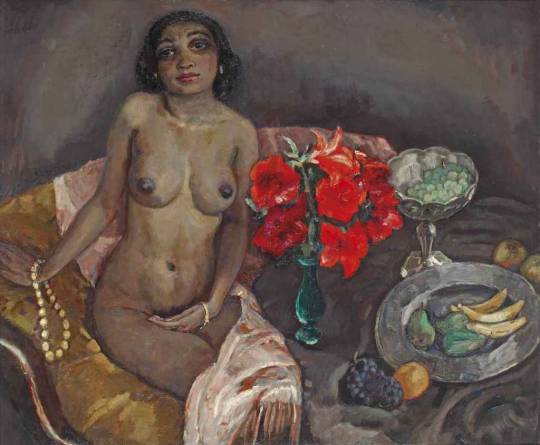
Jan Sluitjers, Seated Nude with Flowers and Fruits, 1927.

Jan Sluitjers, Still Life with Standing Nude,
Gesture
Gestural is a term used to describe the application of paint in free sweeping gestures. Gesture drawing and painting might appear to be a new practice but it was frequently used by Michelangelo – However it is only relatively recently that gestural works have been accepted in their own right and not relegated to the status of a preparatory sketch. There is still a lot to be learned from quick sketchbook drawings, as they reveal traces of the process and adjustments made.
Gestural work requires a confidence and full absorption in the process. It is drawing with your whole body – movements stemming not just from the wrist but from the shoulder, linking the natural gestures of your body with the dynamic shapes of the figure. It helps to hold the brush or pencil loosely and close to the end for freer movement, starting with light marks which allow for adjustments at a later stage.
Michelangelo made quick gestural drawings from life, designed only for himself in order to be worked up into a more laboured and ‘finished’ piece. They capture the essence of his subject in minimal strokes. One of these is ‘Risen Christ’. This study belongs to a set of compositions of the Resurrection of Christ. There are visible traces of repeated changes made to the posture of the legs, before a final composition is settled on. The drawing anticipates the posture of Christ in the Last Judgment in the Sistine Chapel. Marks are made in strong gestural strokes with varying pressure to describe the contours of the muscular body. The preliminary gesture drawing enables Michelangelo to carry this dynamism across into the more finished piece.

Michelangelo, ‘Risen Christ’, 1532.
In 'Little Nude,’ Peploe uses curved lines to describe the figure, made with quick flicks of the brush. These are not restricted to an outline but go within and across the figure. In other places paint is applied in fluid motions with a broader brush. The gestural drawing captures the sense of the curve of the spine as the model reaches out. Once against gestural marks are continued into the background enforcing the impression of a figure occupying a space. Tonal contrast with the background helps to bring the figure out. Peploe’s gestural work associates him with the impressionists with a shared desire to depict the essence of what they are looking at rather than merely represent it.

Peploe, 'Little Nude’ 1930.
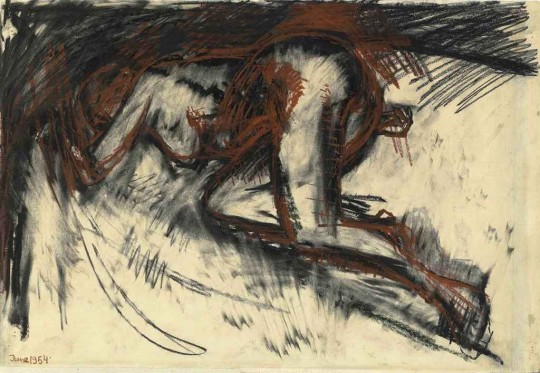
Frank Auerbach worked in an ‘active, extreme and strenuous way’, emphasising the importance of process. His ‘Study of a Nude’, 1954 is made using only two tones – black and brown. A variety of marks is introduced using a smudging or smearing technique as can be achieved with a putty rubber or the fingers. This has the effect of softening his energetic pencil marks in places. Gestural marks have a directionality to them which gives momentum and takes the eye on a journey around the drawing. In Auerbach’s drawing this directionality conveys the angle of the figure which is moving away from us. His gestural marks continue outside the borders of the figure, however this doesn’t matter as the figure can be carved out of them. It is a process of refining that begins with the biggest shapes. His aim is to create a set of relationships between the masses, the space, the sensations and the tense surface character of the picture. He says ‘There is no one-to-one relation of mark to object’, the goal is ‘to put down the mind’s grasp of their relationship’, in an experience which is more haptic than retinal.
Auerbach uses gesture drawing to capture a moment from the past and reanimate it rather than simply recording it. He aims “to pin down an experience in its essential aspect before it disappears”. This suggests that his work is intuitive rather than pre-planned – he is always in search of the unpredictable.

Frank Auerbach, 'Study of a Nude’, 1954.
Strength/Fragility (Rodin)
Rodin’s sculptures were carved in a large, productive workshop, in collaboration with many studio assistants. Out of the strenuous labour and noise of the studio environment emerged a collection of surprisingly sensitive, quiet sculptures of the human figure. One of these studio assistants was the young Camille Claudel, also a sculptress in her own right. Subjects which may be considered ugly to some become beautiful in the eyes of these two artists, due to an expressiveness and strength of character.
Rodin’s Eve remains unfinished because his model, who was pregnant, could no longer hold the pose. Almost twenty years had passed before he felt bold enough to exhibit his incomplete or fragmented works. The rough surface of the skin, the lack of detail and the trace of the metal armature still visible on the right foot all attest to the fact that this was a work still in progress. The modesty of her gesture and the shame which it suggests collide with the sensuality of her body. She takes up a closed variation of a contrapposto pose. Suffering is conveyed by the twist of her body and anguish in her face. Rather than the originator of sin, she appears to represent the frailty of the human condition.

Rodin, Eve, 1881
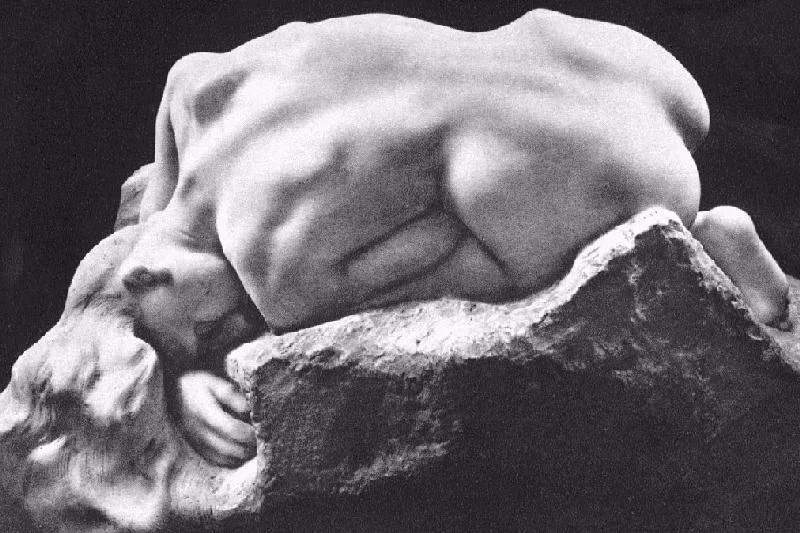
In Greek mythology, the Danaïds were punished for killing their husbands on their wedding night by being made to fill a bottomless barrel with water. Rather than representing the Danaïd in the act of filling the barrel, as in conventional iconography, Rodin strips the subject down to her inner despair as she realizes the pointlessness and absurdity of her task. She rests her head on her arm in exhaustion, ‘like a huge sob’. Rodin constructed a feminine landscape from the curve of her back and neck, culminating in the flow of her hair into the water from her overturned vase. But for all her soft curves and suffering we know she is not a fragile or helpless woman – she stabbed her husband after all. The jagged surface of the rock forms a contrast against her smooth skin. Whilst her hair falls forward to reveal her neck in a soft gesture, the bridge of her back remains strong like a shield for the rest of her body. There is a muscularity in the modelling of her shoulders. Some say that the model was Rodin’s assistant and lover, the sculptress Camille Claudel, whereas others suggest the pose was inspired by a fatigued studio model in rest.
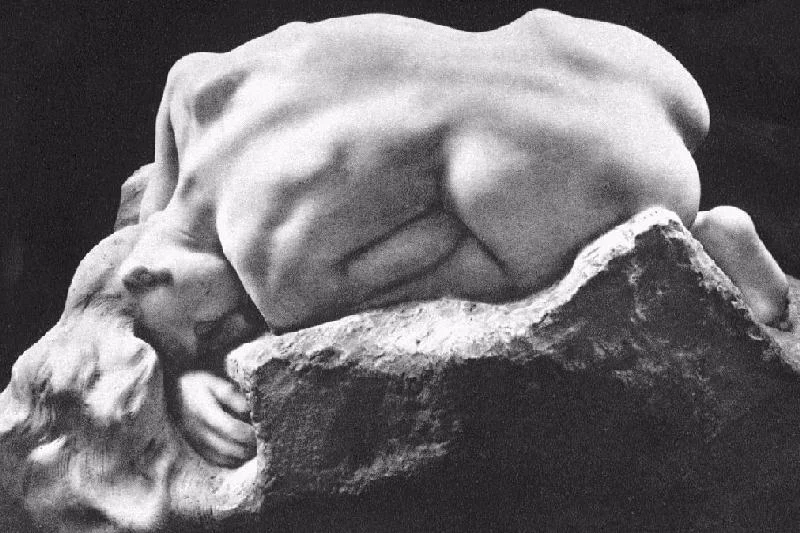
Rodin, Danaid, 1889
Possibly most representative of strength and fragility was the work of Camille Claudel – a strong woman working in the male dominated medium of stone, worn to fragility by the hardships she suffered as a result of her gender. In Rodin’s studio she was often mistaken for a model as it was unusual for a woman to be present in any other capacity. She worked as his assistant as well as creating her own original works, leading her skilful modelling to be often accredited to him. Although she has been characterised as a tragic heroine and victim in popular adaptations of her life story, she was an artist whose work reached critical acclaim independent of her biography. L’Abandon was inspired by an Indian play about Sakuntala’s reunion with her husband after a long separation caused by a magic spell. It morphed into a personal response to Vertumnus and Pomona in Ovid’s Metamorphoses. The female figure stands over the kneeling male. Pomona was the nourishing goddess of fruits – she is supported by strong and muscular legs. Vertumnus clasps her in an arduous embrace, straining his neck to reach her. She appears to give in to his attentions despite efforts to resist. One of her arms hangs limply at his side, the other protects her heart. Although she is depicted in the process of submitting, she is eternally suspended between independence and commitment. The arrangement speaks of a mutual dependence. Rodin’s refusal to give up his wife for Claudel and being forced to live in his shadow drove her to paranoia. Her career was tragically brought to a premature end and she was committed to a mental asylum for the last 30 years of her life.
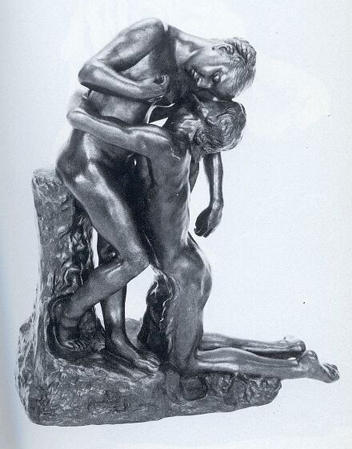

Camille Claudel, Vertumnus and Pomona / L’Abandon, 1886
Naked/nude
The definitions of Naked/Nude have evolved gradually throughout the history of art. Diderot first declared partial nudity as indecent in 1767. In his opinion a partially clad women is dressing up deliberately to provoke men, whereas a fully ‘nude’ woman is innocent in her natural state. ‘Imagine the Medici Venus is standing in front of you, and tell me if her nudity offends you. But shoe this Venus’ feet with two little embroidered slippers. Dress her in tight white stockings secured at the knee with rose-colored garters. Place a chic little hat on her head, and you’ll feel the difference between decent and indecent quite vividly.’
Kenneth Clarke claimed in 1956 that the word ‘nude’ was invented to justify the naked human body as a worthy artistic subject. So the nude refers to an artistic genre – the balanced, prosperous, and confident body, but to be naked is to be deprived of clothes, implying embarrassment.
Sixteen years later John Berger gives nakedness a more positive slant – for him, to be naked is to be oneself – without the objectification that is applied to the ‘nude’. So for example an artist might paint his wife naked instead of nude, conveying intimacy. He says that whilst nakedness reveals itself, nudity is placed on display (usually for the male gaze).
Donatello’s David is one of the first artworks to feature the semi-nude figure, described by Kenneth Clark as ‘a work of incredible originality’. It shows David triumphant after killing Goliath, whose severed head lies beneath his feet. David is nude save for his sandals and a helmet – but does this make him naked? These items of protective clothing appear out of place, bookending his bare skin. David was traditionally depicted as a bearded king, far from the sensuous youth envisioned by Donatello. Many have speculated on Donatello’s sexuality, suggesting that this offers an explanation for the homoerotic overtones we see in the work today. To the Renaissance viewer the sculpture's lack of clothing may have called to mind the heroic nudity of antiquity, comparing David to the Gods and heroes of the classical world. Either way, it was a bold statement to make in the centre of the courtyard in the Palazzo Medici, home to the most prominent family in Florence.

Donatello, David, 1440s
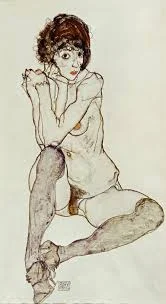
Egon Schiele is known for his semi-nudes, exploited for their provocative potential. Their eroticism is emphasised by the suggestion that they are in the process of undressing, or revealing themselves for the voyeur. No doubt Diderot would have found them highly indecent! Stockings for example would have associated them with prostitutes - combined with ‘imperfections’ such as body hair, these items of clothing sever the naked body from its classical associations. In their place a humanity and expressiveness is allowed to come through. Schiele’s woman is intensely aware of the viewer just as we are intensely aware of her nakedness.

Egon Schiele, Seated Female Nude, 1914
Semi nudity or nakedness is also employed in feminist art by women using their own bodies. VALIE EXPORT’s ‘Action Pants’ is a set of photos in documentation of a piece of performance art in Munich in 1968. They show her sitting outside on a bench wearing crotchless trousers and a leather shirt, holding a machine-gun in front of her chest. Her feet and genitals are bare and vulnerable. Her level of attire is the inverse of Schiele’s women, and somewhat unconventional. These touches of feminine vulnerability are juxtaposed with the aggressive, phallic imagery of the gun with which she appears to threaten the viewer, as well as her confrontational stance. She is said to have carried out the performance during a pornographic showing in a cinema, walking through the audience, her exposed genitalia at face-level. This confrontation aimed to challenge the historical representation of women as passive objects without agency, in cinema as well as art. The image also questions the sexualisation of the female body - when divorced from the rest of the body is it possible for an individual feature to be inherently erotic?

VALIE EXPORT, Action Pants: Genital Panic, 1969

![Getting [un]dressed](https://images.squarespace-cdn.com/content/v1/5c2034e75417fc423a175501/1546812354542-7HAONZ3KCRZYKTCSW109/Antoine+Watteau%2C+The+Toilette%2C+1717.%C2%A0.jpg)